

Japan’s cupboard authorized a Fiscal 12 months 2025 supplementary finances that’s poised to place the nation on monitor to dedicate upwards of two % of its GDP to protection.
The supplementary finances consists of an extra $7 billion – or 1.1 trillion yen – for protection spending for Japan’s present fiscal yr, which can conclude March 31, 2026. If authorized by Japan’s Parliament, the finances will carry whole protection spending for the fiscal yr to $70 billion – 11 trillion yen – and can exceed 2 % of Japan’s GDP, a goal the earlier Kishida administration had set to attain in FY2027.
“Mixed with the preliminary finances of roughly 9.9 trillion yen, the overall quantity will probably be roughly 11 trillion yen. Because of this, it may be stated that in FY2025, now we have already achieved the two % of GDP stage set out within the Nationwide Safety Technique,” Japan Protection Minister Shinjiro Koizumi stated Tuesday throughout a press convention.
The Kishida administration set the FY2027 goal in December 2022 as a part of three strategic paperwork it launched that month: the Nationwide Safety Technique (NSS), the Nationwide Protection Technique (NDS) and the Protection Buildup Program (DBP).
Nonetheless, in her first coverage speech to Japan’s Parliament in October, newly minted Prime Minister Sanae Takaichi stated the safety atmosphere had modified for the reason that paperwork had been issued, and Japan wanted to take the initiative to strengthen its protection capabilities. On the time, Takaichi expressed her intention to carry the FY2025 protection finances as much as 2 % of the GDP goal by way of the supplementary finances, in addition to revising the three strategic paperwork by the yr’s finish.
The Ministry of Protection (MOD) supplementary finances doc exhibits that the MOD could be allotted 842.7 billion yen with the rest of the 1.1 trillion-yen allocation being given to the Japan Coast Guard and different ministries and companies which have protection undertakings.
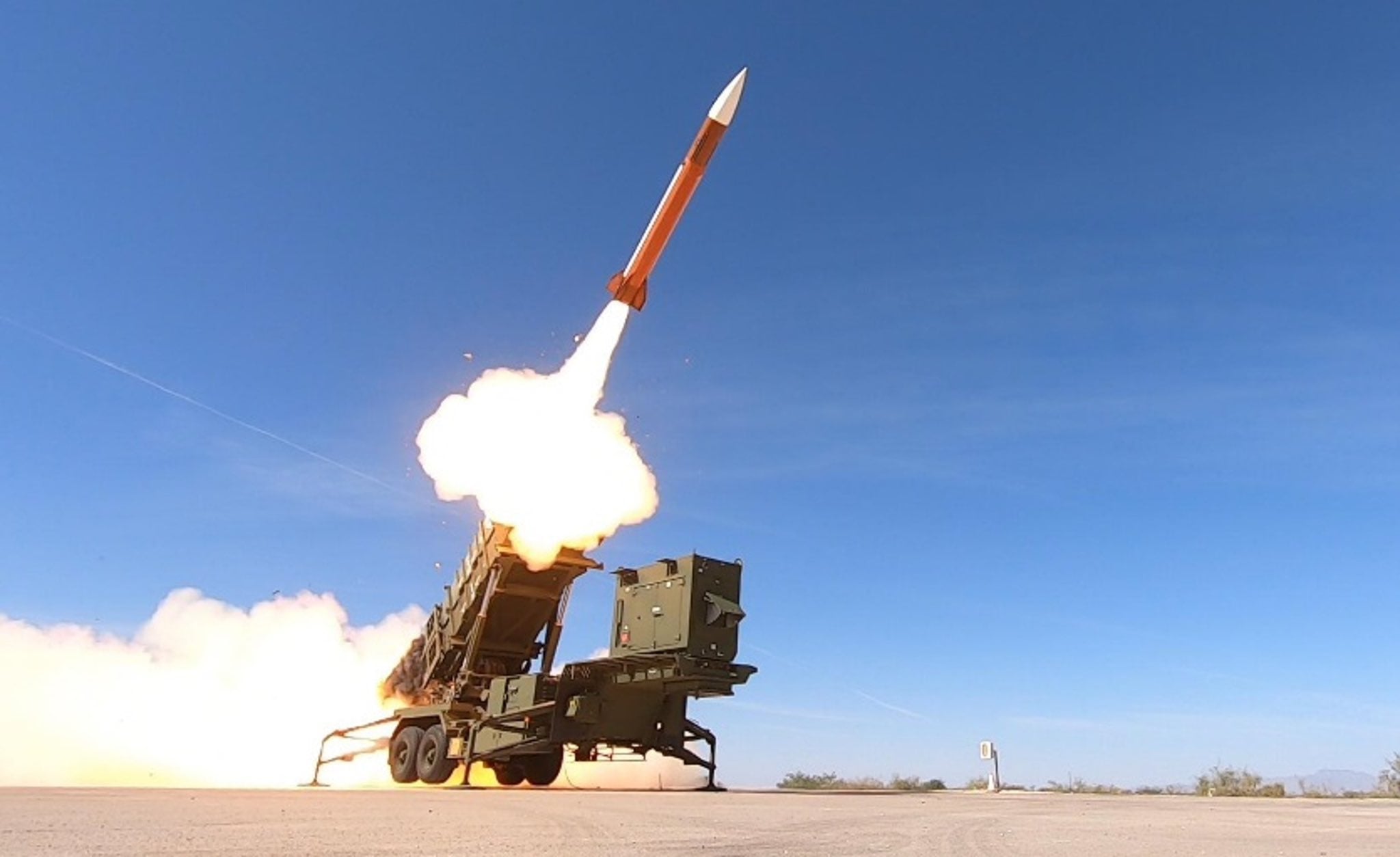
Among the many gadgets the MOD allotted for are 167.4 billion yen for elevated pay, improved barracks and personnel assist amenities; 122.2 billion yen for guaranteeing operational readiness of plane and ships; and 56.6 billion yen for buying numerous munitions, together with the early improvement of Improved Sort 03 medium vary Floor-to-Air Missiles (SAM).
Moreover, 345.1 billion yen will probably be allotted for the realignment of U.S. Forces in Japan and can cowl constructing amenities on Mageshima Island, which can function a Discipline Provider Touchdown Observe coaching base, and the event of the Henoko base on Okinawa that’s set to exchange Marine Corps Air Station (MCAS) Funtema.
The MOD has additionally budgeted 2.9 billion yen for drone response gear, 4.8 billion yen for a brand new provide depot on Okinawa and 16 billion yen for the event of amenities to obtain cell air protection and management radars on Kita Daito Island. Japan plans to base a cell radar there to reinforce its surveillance on its Philippine Sea facet as a consequence of its proximity to Taiwan and elevated Chinese language army exercise, USNI Information beforehand reported.
Progress has been sluggish owing to Japan’s have to have municipal authorities and residents to assist the stationing and institution of army gear and bases of their neighborhood. This has resulted in Tokyo opting to largely station surveillance techniques and defensive weapons on the varied islands and depend upon cell anti-ship missile batteries quickly deployed to the world. Japan Maritime Self-Protection Power (JMSDF), Japan Air Self-Protection Forces belongings and long-range missiles to additionally present offensive capabilities.

Final week, Koizumi pushed again in opposition to China’s declare that Japan was deploying offensive weapons to Yonaguni Island, positioned close to Taiwan, as a deliberate transfer to escalate tensions and produce army confrontation. Koizumi stated Nov. 25 in his recurrently scheduled press convention that the Sort 03 medium vary SAM system that might be deployed to the island is defensive in nature and is supposed to counter assaults on army and civil amenities on the island. Someday prior, on Nov. 24, China Overseas Ministry spokesperson Mao Ning had condemned Tokyo’s plans to deploy SAMs on Yonaguni.
“Japan’s deployment of offensive weapons in Southwest Islands near China’s Taiwan area is a deliberate transfer that breeds regional tensions and stokes army confrontation,” Mao stated, in keeping with a transcript.
Koizumi reiterated in his Nov. 25 press convention that the medium vary SAM unit was tasked for air protection in opposition to plane and missiles.
“It’s a unit designed to guard the island and defend Japan. In different phrases, that is gear for defensive functions, not for attacking different international locations,” Koizumi stated.
Plans to deploy the missiles have been in place since 2022.
China routinely operates between Yonaguni Island and Taiwan whereas conducting reconnaissance missions off Taiwan’s east coast. A suspected Chinese language unmanned air car (UAV) flew between Yonaguni Island and Taiwan, in keeping with the Japanese protection minister. The following day, Japan’s Joint Workers Workplace (JSO) issued a information launch detailing the drone’s flight path.
The suspected Chinese language UAV was confirmed to have arrived from the East China Sea, passing between Yonaguni Island and Taiwan and getting into the Philippine Sea. The drone later handed between Yonaguni Island and Taiwan once more to return to the East China Sea, in keeping with the discharge. In response, fighter jets from the Japan Air Self-Protection Power’s (JASDF) Southwestern Air Protection Command had been scrambled.
It’s unclear if the UAV flight was in response to Koizumi’s remarks or if it was a routine mission.
The Individuals’s Liberation Military Navy (PLAN) Liaoning Provider Strike Group additionally sailed within the waters between Yonaguni and Iriomote Island in September 2024 to deploy to the Philippine Sea. Yonaguni Island lies round 67 miles east of Taiwan and is the western most Japanese island.
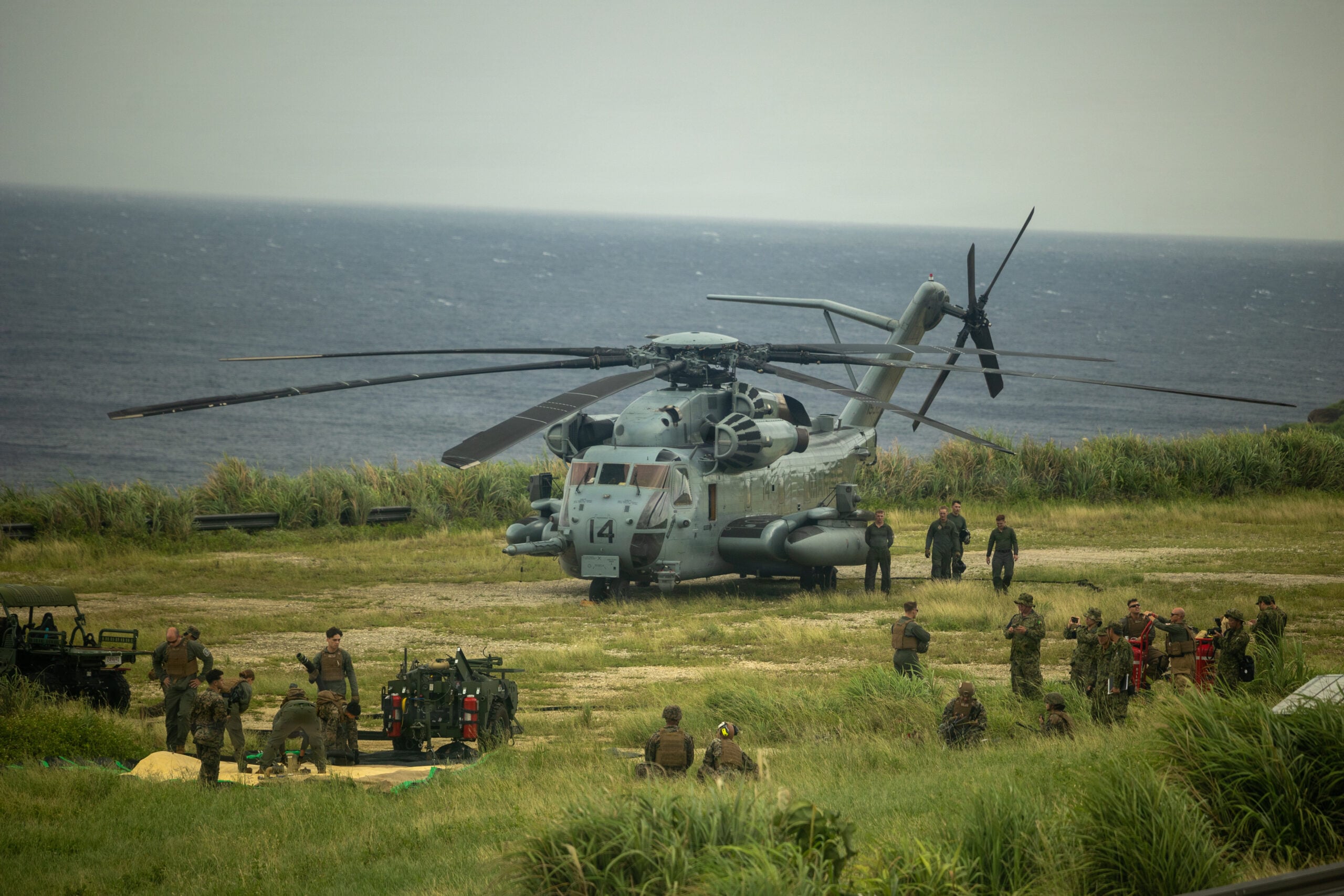
The U.S. Marine Corps have performed drills on the island, deploying a cell radar there in August 2024 as a part of the Resolute Dragon 24 train. This yr, on Oct. 27, Marine Heavy Helicopter Squadron (HMH) 462 and Marine Wing Assist Squadron (MWSS) 172, Marine Plane Group (MAG) 36, 1st Marine Plane Wing (MAW), established a ahead arming and refueling level (FARP) on the island throughout Joint Train 07 alongside the Japan Floor Self-Protection Power (JGSDF).
“The operation bolstered U.S. Marine and JGSDF bilateral interoperability and demonstrated 1st MAW’s capability to assist shared aims wherever throughout the first island chain,” reads a Marine Corps launch.
The drill was the primary time a FARP was established on Yonaguni. The HMH-462 transported MWSS-172 Marines and FARP gear from Okinawa, Japan, to Camp Yonaguni, Japan, utilizing en route air-to-air refueling with a KC-130J.
Upon touchdown at Camp Yonaguni, MWSS-172 Marines shortly arrange a FARP utilizing the Tactical Aviation Floor Refueling System (TAGRS). After demonstrating the FARP’s performance by refueling HMH-462’s CH-53Es, the FARP was dismantled, and the MWSS-172 Marines had been extracted again to Okinawa, in keeping with the discharge.
Source link


