

Japan-based Marines held the primary Marine Corps Assault Drone Competitors, certifying troops as operators in preparation for bringing the brand new expertise to the battlefield.
Marines from the third Marine Division, III Marine Expeditionary Power (MEF), skilled to make use of the Neros Archer first-person view assault drone in the course of the competitors, which started Dec. 3 and concluded Friday, at Camp Hansen and Camp Schwab in Okinawa, Japan.
“The Marine Corps Assault Drone Competitors permits Marines to check and enhance their drone expertise alongside the highest operators within the Marine Corps, enhancing their confidence and capabilities on the battlefield,” stated teacher Sgt. Grant Doran, with the Marine Corps Assault Drone Workforce in Quantico, within the Friday information launch. “It additionally lets us practice the individuals who will probably be taking on our positions sooner or later. Different branches had been additionally in a position to deliver their prime operators in, so we are able to share our ideas and tips to extend lethality throughout all companies.”
The competitors licensed third Division Marines as assault drone operators and instructors and payload specialist instructors, giving them the power to make use of first-person view assault drones, in line with the discharge. The Neros Archer drone extends the Marines’ understanding of the battlespace by 20 kilometers.
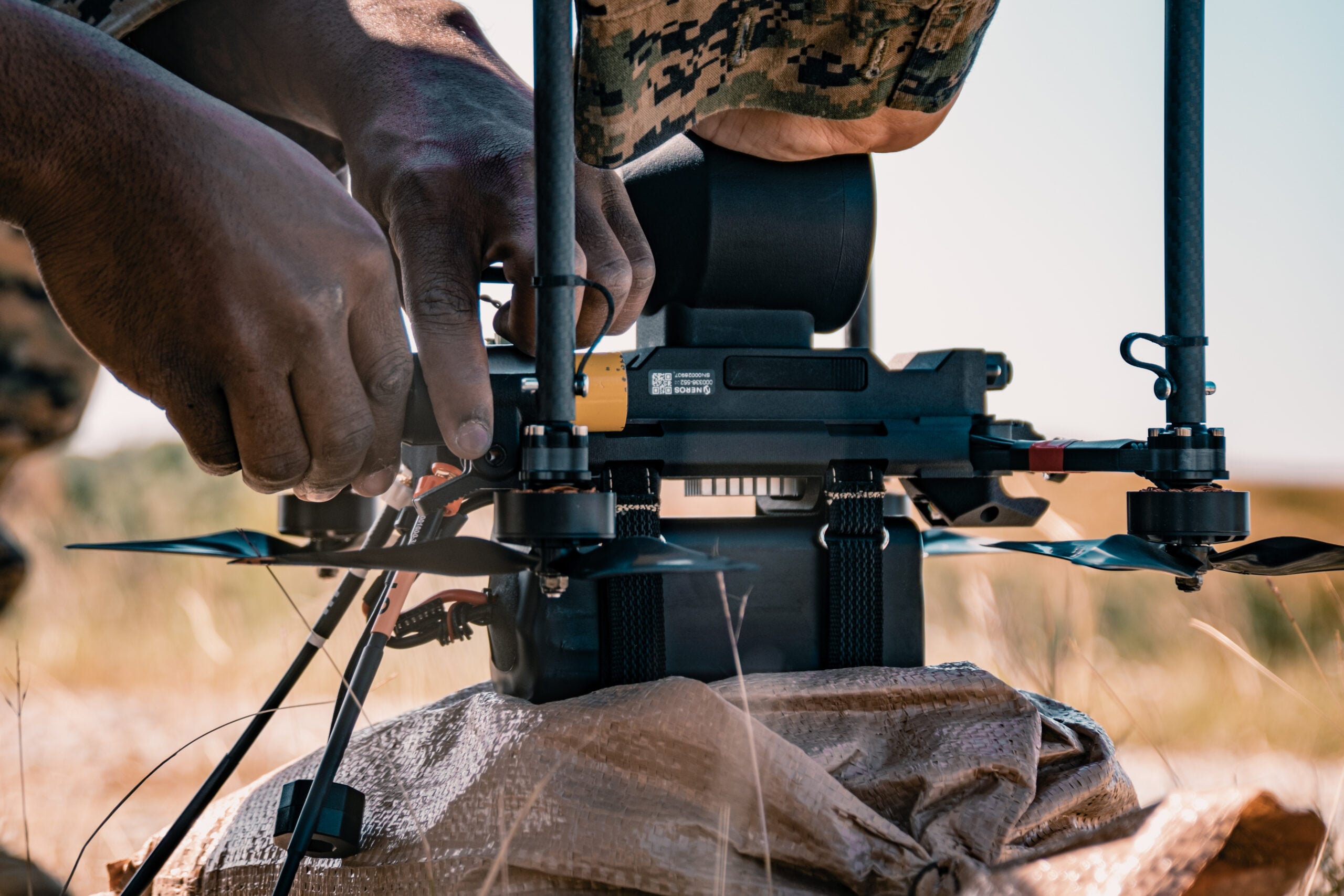
The Marine Corps in September issued formal steering for fielding the Neros Archer. Producer Neros introduced in November that the corporate had obtained a multimillion greenback contract to supply superior small unmanned aerial methods (sUAS) throughout the Fleet Marine Power.
Neros Archer just isn’t the one sUAS being fielded by III MEF. In early November, third Battalion, twelfth Marine Regiment, third Marine Division, performed their first official flight of the brand new Skydio X2D sUAS – used for reconnaissance – at Camp Foster in Okinawa, in line with a Marine Corps information launch.
“The U.S. Marine Corps is quickly increasing its use of sUAS, marking a serious step ahead in modernizing intelligence, surveillance and reconnaissance capabilities throughout the power. The sUAS was as soon as considered as a small asset, however now they’re rising as indispensable instruments in help of operational calls for throughout the Indo-Pacific,” reads the discharge.
The primary flight demonstrated a broader shift in how third Marine Division is making ready for future battle with the combination of the system into intelligence assortment plans permitting Marines to construct a extra full image of the operational setting, even in distant or contested areas.
The Marine Corps can also be working by itself drone modifications and designs. Marines from the III MEF’s Expeditionary Operations Coaching Group’s (EOTG) Unmanned Methods Department are growing first-person view drones that may be remotely piloted or programmed for autonomous flight, in line with a Marine Corps information launch.
Following classroom instruction and sensible utility, Marines operated the drones in Camp Schwab’s coaching space, conducting each piloted and autonomous flights. Throughout the train, they struck a number of targets throughout the vary utilizing inert coaching payloads, a required milestone earlier than using reside ordnance, in line with the discharge. The coaching was a precursor to the primary live-fire train in Okinawa with the Marine Corps Assault Drone Workforce in December.
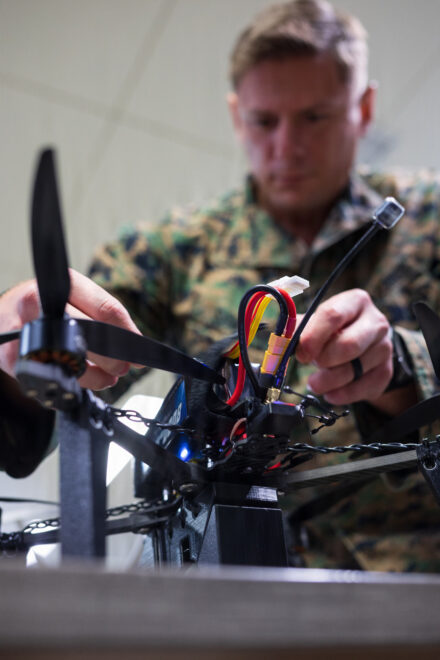
Utilizing additive manufacturing, Marines created customized adapters for the drones, together with modifications to hold M67 fragmentation grenades. The modifications diminished the procurement course of and decreased the time from idea growth to manufacturing. It additionally marked the primary time drones with additive manufacturing methods have been fielded in Okinawa. Throughout the month-long effort, Marines gained proficiency in constructing and programming quite a lot of drones with totally different payload configurations, the information launch reads.
“The actual functionality lies in our Marines’ means to design, construct and program these methods. If a commander wants a drone to intercept a helicopter, strike a ship, or increase a communications community, we are able to construct and deploy it shortly,” stated Maj Brant Wayson, the Unmanned Methods Department officer-in-charge. “No matter functionality is required, we are able to make it occur. We’re making certain our Marines are geared up to fulfill any problem on the battlefield.”
Marines in Japan have additionally been engaged on constructing their very own elements and instruments for the service’s amphibious fight automobiles (ACV), in line with a November information launch. The Common Assist Upkeep Platoon, in live performance with the Manufacturing Platoon of the third Upkeep Battalion, third Marine Logistics Group, are constructing ACV secondary repairable (SECREP) capabilities past the normal scope of an intermediate-level restore facility.
SECREP restore procedures are offered and validated from the tools’s respective program workplace and Marine Corps Logistics Command, however such a course of presents distinctive challenges to the forward-deployed third MLG and the Assault Amphibious neighborhood as a complete.
“We’re working on the opposite aspect of the world from the distributors, and elements acquisition is harder when forward-deployed,” stated Sgt. Aidan Scott, platoon sergeant of the platoon, within the launch. “A few of the particular instruments required for numerous repairs don’t exist within the Marine Corps or they aren’t being totally provided but, however the ACVs are right here and operational in Okinawa.”.
The GSM platoon, working carefully with the Superior Amphibious Assault Program Supervisor and III Marine Expeditionary Power (MEF) ACV subject service representatives, are reviewing ACV work packages and technical manuals to find out how finest to manufacture parts that aren’t available. Parts made by the manufacturing platoon then endure a validation and verification course of, making certain the elements match the parameters specified by the technical manuals, in line with the discharge.
So far, 9 crucial parts have been repaired on the intermediate upkeep degree inside III MEF, together with ACV propeller shafts, hydraulic motor parts and the wheel finish meeting, which is without doubt one of the most in-demand ACV objects for restore throughout the power. Together with the time-saving ingredient of producing particular instruments and conducting repairs whereas forward-deployed, the Marine Corps estimates upwards of $75,000 mixed value financial savings has occurred.
“Being within the first island chain, we don’t have the luxurious to attend for somebody to determine this stuff out for us,” stated Chief Warrant Officer 2 Aaron Sitka, officer-in-charge of the GSM Platoon, “Can we do it; what clarifications do the TMs want; and may we keep on with the restore necessities with what we presently have? That’s the sport plan. That’s the job although; we have to help ACVs as they’re a service-defining functionality.”
Amphibious fight automobiles joined III MEF in June 2024 and have been working in Okinawa since January 2025 with 4th Marine Regiment, in line with the discharge.
Source link


