

Kate Ashe Leonard finds peaceable anchorages, thrilling wildlife, and human connection whereas exploring the Indonesia islands onboard her catamaran Polaris.
Fleeing bait fish ping towards our hulls whereas troops of shrimp crackle like frying bacon as they drift previous. A pink painted fishing boat is anchored among the many shallow reefs up forward, its skipper dozing within the light daybreak.
Diving in off our again step, I swim towards the present, grabbing maintain of our anchor chain. Polaris’s twin hulls body a white sandy spit topped with three leaning palm timber, shelving into mild then darkish blue sea.
We’re cocooned off each port and starboard by two larger islands cloaked in lowland forest and surrounded by twinkling historic granite boulders.
These are the Anambas islands, Indonesia’s northernmost sea border archipelago. They’re dotted with conventional villages suspended over water on wood stilts, gushing waterfalls, silica sand seashores and empty, well-protected anchorages, making them a dream vacation spot.
Polaris on a gradual passage to Kupang. Photograph: Jim Hooper
Between Peninsular Malaysia and the island of Borneo, solely 25 of those 255 islands are inhabited.
We arrived in Indonesia on our Catana 47 Polaris 10 months in the past and, though it’s not the simplest place to cruise, the 1,900-miles we’ve explored within the nation has been an unforgettable chapter in our circumnavigation thus far.
Indonesia is unfold throughout greater than 17,500 islands that stretch between the Pacific and Indian Oceans, and surfers can trip lengthy, constant swells shaped from each oceans.
Positioned inside the Ring of Hearth, it has the best variety of energetic volcanoes on the planet, and the multitude of habitats – from savannahs and tropical rainforests to mangrove swamps and coral reefs – are residence to fascinating wildlife; from Komodo dragons to critically endangered tigers, elephants and orangutans endemic to Sumatra and Borneo that roam within the wild.
The climate whereas cruising in Indonesia
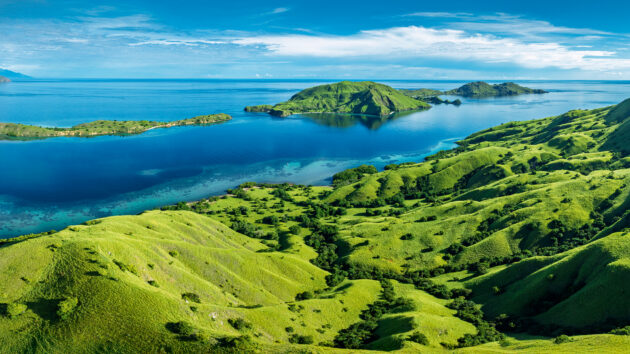
Komodo Island – and others inside Komodo Nationwide Park – turns spectacularly inexperienced through the moist season. Photograph: Jim Hooper
Indonesia is out of the cyclone belt and its proximity to the equator means mild wind is regular year-round; all however essentially the most affected person sailors are likely to burn a number of diesel.
Nevertheless, there are two monsoon seasons to think about.
From June till September, dry season situations with south-east winds cowl a lot of southern Indonesia.
On the similar time, north of the equator elements of Aceh, Kalimantan and Sulawesi are of their south-west moist season.
Then between December and the top of February the southern moist season brings stormy climate with north-westerly winds, whereas the northern areas expertise north-easterlies and drier situations.
Transitional climate with mild wind within the months between seasons can present home windows to make method in instructions in any other case untenable as a result of monsoons.
Land and sea

Padar Island within the Komodo Nationwide Park. Photograph: Jim Hooper
Departing Darwin we’re on a broad attain. Out of the lee of Bathurst Island the wind accelerates and has us dashing alongside at eight knots, nevertheless it’s short-lived and by day two we drop our sails and motor by means of glassy water.
Once we arrive at Kupang, our port of entry in Timor, our plan is to make our method west utilizing the final of the south-easterlies so far as Lombok, the place we’ll cease for the southern wet season.
In contrast to our yr spent crusing Australia with clear and strictly enforced rules, we’re anticipating unmarked fishing vessels, a number of plastic air pollution and prolonged officialdom clearing in.
However on this sweltering three-night passage, the variety of obstacles within the water are few and much between till the final 50 miles. The plastic, nonetheless, is heartbreaking and checking in does take two and a half days.
Spinner dolphins information us south-west in direction of the powder white sand of Rote Island. Picket villages fringe the coast en path to the city of Nemberala the place uncrowded breaks entice surfers from everywhere in the world.
Like many Indonesian coastal communities, although, Rote remains to be reliant on agriculture and fishing. We squeeze in amongst about 30 huge fishing trimarans and for 3 weeks we rise at daybreak and paddle out to the closest break.
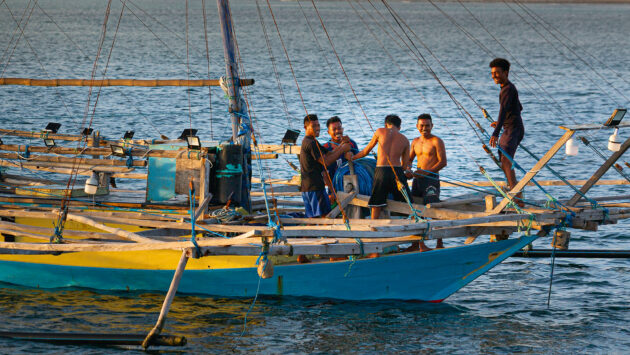
Indonesian fisherman elevating their anchor at Rote Island, a part of the Sunda group the place fishing remains to be a main supply of revenue. Photograph: Jim Hooper.
After our fill of browsing, we set a course north-west whereas the winds are nonetheless pumping. Retaining no less than 50 miles off the north coast of Sumba to keep away from fishing vessels, we spend the 300-mile passage reaching below mainsail and genoa.
The warmth of Indonesia is hard however the wind fills our sails and helps hold us cool.
Utilizing PredictWind forecasts and gathering native data earlier than our departure, we handle to choose up beneficial present as we proceed north in direction of Rinca island, our first cease within the Komodo Nationwide Park islands.

Approaching Rinca Island within the Komodo Nationwide Park. Photograph: Jim Hooper
On this space there are dozens of breathtaking anchorages on the foothills of sloping savannah-covered islands, hemmed by vibrant, thriving coral reefs. Ashore we spot monkeys within the timber, deer within the shallows and water buffalo grazing on the hills.
These islands are each a terrestrial and marine park – the identical day we go to the ferocious Komodo dragons, a resting sperm whale exhales simply exterior our anchorage.
Our time right here is blissful; mornings are punctuated by hikes up scorched brown hills that can slowly flip inexperienced when the rains come, and afternoons drift snorkelling within the present with sharks, turtles and dozens of manta rays beneath us.
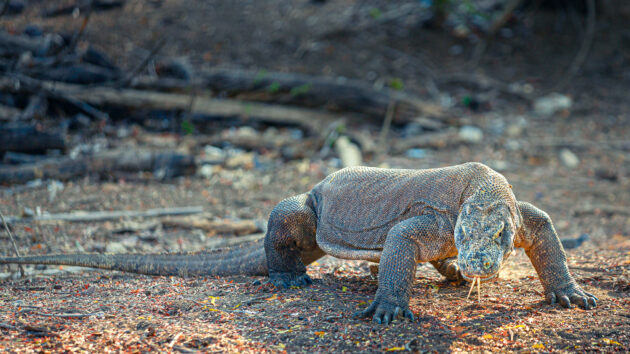
The fearsome Komodo dragon shouldn’t be current on Padar however is discovered on different islands inside Komodo Nationwide Park. Photograph: Jim Hooper
Managing the tropical warmth whereas cruising Indonesia
The humidity rises because the seasons transition and we have to hold transferring.
Subsequent, Sumbawa beckons, its moody volcanic craters smouldering to the west. With our sails full we race previous Mount Tambora, whose eruption precipitated a world cooling occasion nicknamed the ‘12 months And not using a Summer time’ in 1815. As we speak, it seems reassuringly sedate.
Persevering with west, Satonda island, with its volcanic crater lake inside, has a novel anchorage with entry to a hike across the crater’s edge, whereas Moyo island affords glorious diving.
However maybe the most important spotlight is Saleh Bay, the place huge Whale sharks congregate round fishing platforms for a straightforward meal.
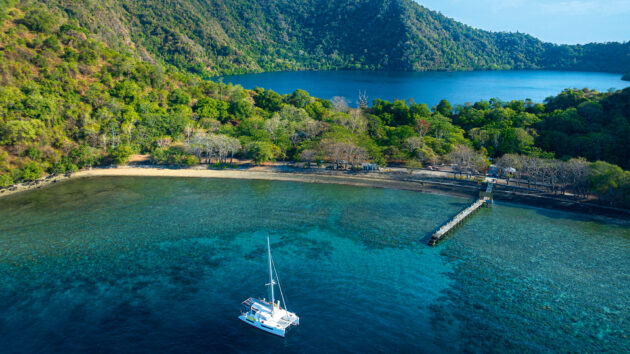
Anchored off the pier giving entry to the volcanic crater of Satonda Island and its lake inside. Skilled hikers can traverse the entire crater rim on a mud path.Photograph: Jim Hooper
Gili Islands
After a number of day-hops, we attain the sensible blues of Lombok’s well-known Gili islands.
It’s late October and the warmth varieties an enormous thundercloud above Rinjani, the second tallest volcano in Indonesia. When the storm hits it’s sudden and violent: the wind shifts and climbs to 30 knots.
At anchor, Polaris’s bows gallop over a rising swell whereas lightning flashes ever nearer. Waves pound the seashore and two fishing boats break away.
Moist season comes early this yr and the north-west winds will quickly forestall sailors from safely persevering with west.
However our want to discover Indonesia slowly, plus a household vacation on board, means we pause our journey in Lombok. With a world airport, a boatyard and a very good marina, it’s handy.
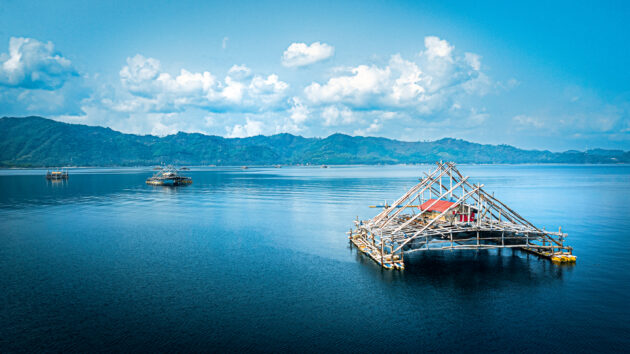
Cruising previous fishing platforms as Polaris heads to south-west Lombok. Photograph: Jim Hooper
Presently of yr, the most effective shelter is in south-west Lombok. The wind hasn’t fairly switched north-west but and so the passage south alongside the west coast could be very sheltered by the principle island.
Nonetheless, a big swell generated within the Lombok Strait repeatedly smashes towards our starboard beam as we elevate our mainsail and motor-sail for 40 miles, passing dozens of wood fishing platforms adorned with lights and draped with fishing nets which are frolicked at night time.
Slightly archipelago often known as the Secret Gili islands is sprinkled alongside this shoreline, nonetheless untouched by mass tourism regardless of being a mere 90-minute speedboat trip away from neighbouring Bali. This space turns into our base for the approaching months.
Conventional each day markets are the beating coronary heart of village life throughout Lombok. Girls sit arranging buckets of silver fish whereas different distributors promote hen, tempeh, greens, stacks of fruit and heaps of grains and nuts.
Flexing our fundamental Bahasa, and with slightly assist from native folks, we collect what we want every week.
Lighting catastrophe whereas cruising Indonesia
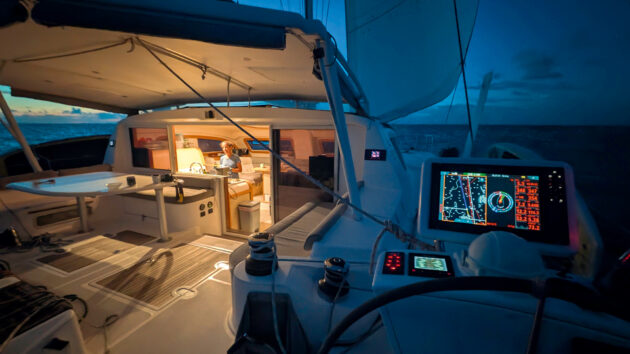
Night time watch below sail. Photograph: Jim Hooper
Monsoonal deluges of rain and thunder and lightning storms are virtually each day occurrences by November, when our boat sustains an oblique however damaging strike.
I used to be standing within the saloon space when the entrance window full of purple and inexperienced mild.
The flash and virtually simultaneous bang have been terrifying, and Jim and I lunged to disconnect our lithium batteries in time.
Within the weeks that observe, we discover our devices are malfunctioning and Polaris’s depth sounder is totally lifeless.
Locals inform us that is the worst wet season in years. Low stress programs spin up from northern Australia and on just a few events our devices learn over 40 knots. Rivers flood, breaking their banks, spilling particles that poses a severe danger to yachts.
Transferring between anchorages after a storm, we dodge large floating logs and are confronted with the worst plastic marine air pollution we’ve ever seen – many islands have little to no waste assortment or processing amenities.
The Java Sea
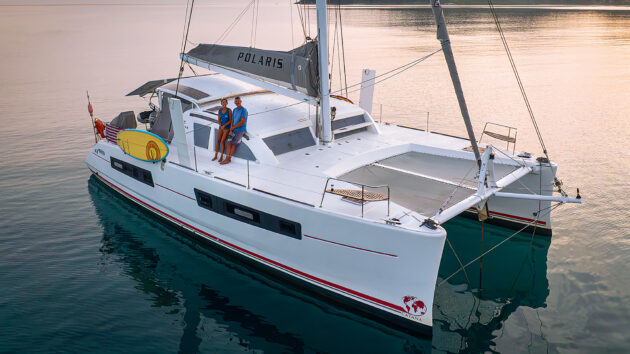
Nonetheless waters for Polaris within the Anambas archipelago. Photograph: Jim Hooper
The seasons are gradual to transition and it’s early Could by the point the north-west winds lastly peter out sufficient to go west. Timing the crossing of the strait that separates Lombok from Bali is essential, because it’s identified for robust currents and excessive waves.
We motor-sail throughout the widest, northern half on a light-weight wind day with out incident.
Bali’s volcanic north coast is hanging and has good holding in black sand, though inlets and coves are missing. Nets marked by flags set generally a whole lot of metres aside, interspersed with dozens of FADs (Fish Aggregating Gadgets), imply this space requires shut consideration.
We’re on a decent schedule, however earlier than crossing the Java Sea, visits to Banyuwedang’s scorching springs and diving off Menjangan island are distinctive experiences.
Subsequent, we head north-west in direction of Kalimantan, Borneo.
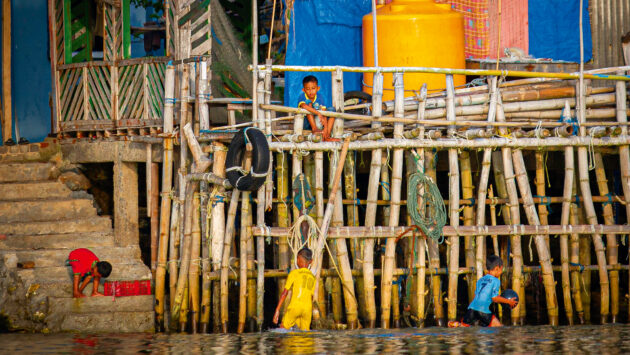
Stilt home on Bawean Island. Photograph: Jim Hooper
The Java Sea is Indonesia’s maritime freeway and an intimidating physique of water to navigate; a serious fishing floor and transport artery, it connects Indonesian ports and likewise intersects worldwide transport routes.
Because the solar dips under the horizon, fishing fleets (with no AIS) glow like a metropolis within the distance; their white, purple and inexperienced lights initially seem blindingly shut, however actually we motor in direction of them for hours.
Smaller vessels, barely seen by comparability, flash torches to sign their presence. Within the lifeless warmth of a windless passage, we meander between vessels like this for 2 days straight till, exhausted, we attain Bawean island, a welcome midway cease in the midst of the Java Sea.
Daybreak breaks as our bows minimize by means of shallow aqua water, dodging reefs off Bawean’s east coast.
Harking back to some Pacific islands we’ve skilled, Bawean is mountainous and lined in rainforest. From the northern anchorage, minarets and the domed roofs of mosques are seen.
Ashore we hike previous glistening rice paddy fields, and a college the place the kids run out from class and observe us playfully up the road.
Again on board, we plan our onward route and put together to depart. The CAPE index is extraordinarily excessive from right here to Kalimantan and so far as Singapore with lightning forecast for the following ten days.
However as we strategy the equator unstable climate is an unavoidable attribute year-round and we depart feeling considerably apprehensive.
Orangutans up river
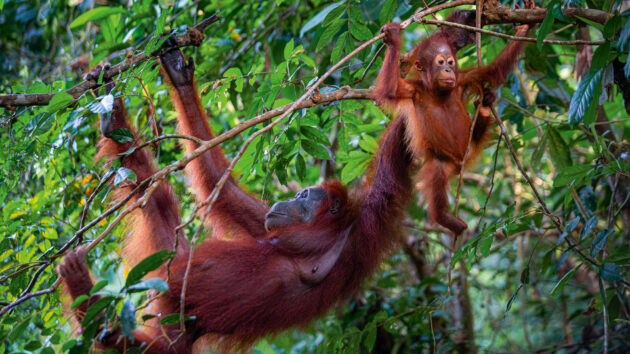
Orangutans at Tajung Puting Nationwide Park. Photograph: Jim Hooper
The south-east winds should not but absolutely established and our angle is tight on the wind for 180 miles, till the muddy mouth of Kalimantan’s Kumai river comes into view.
We’re tense as we enter the river: we changed our depth sounder after the lightning strike however haven’t calibrated it appropriately and depths of 5m learn as 2m.
In addition to being a transport terminal, the city of Kumai is well-known for its ‘fowl’s nest motels’. Dwarfing the as soon as quaint village, tower blocks fitted with audio system play fowl tune all day lengthy to entice the birds to nest in, the nests are then offered into the profitable Chinese language fowl’s nest market.
Throughout the river lies Tajung Puting Nationwide Park, an space of rainforest residence to the most important inhabitants of untamed orangutans on the planet. That is the explanation we got here right here, and we’ve booked a two-day river boat tour.
From a standard klotok riverboat I lookup because the solar casts splinters of sunshine by means of the timber whereas our captain navigates up the narrowing river. A semi-submerged crocodile disappears into tea-coloured water, hornbills glide above the timber and proboscis monkeys scuffle alongside the banks.
We whizz by crooked, stilted fishing huts till we attain a pontoon. We observe our information alongside a rickety bridge, then he stops abruptly and factors.
Burnt orange shaggy hair emerges from emerald foliage: the wild feminine nice ape swings in direction of us, then positions herself the wrong way up and gazes approvingly on the juvenile she is nursing, tightly gripped to her aspect. Not far behind a bigger male is climbing up into the swaying cover.
As the top of Could nears the wind blows extra persistently from the south-east. Again on Polaris we unfurl sails as we exit the Kumai river, passing barges piled excessive with timber.
Our subsequent cease is Belitung island, off the east coast of Sumatra, 300 miles west.
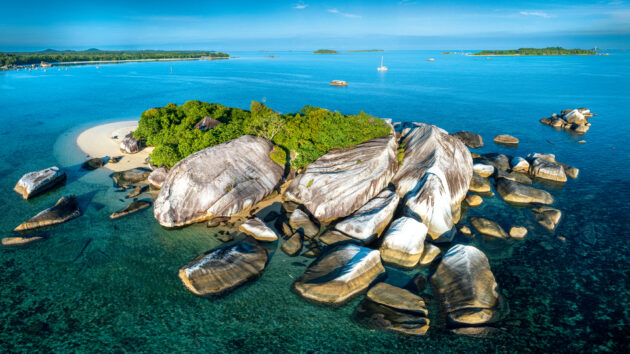
Anchorage on the island of Belitung on the east coast of Sumatra, Java Sea. Photograph: Jim Hooper
The present accelerates fiercely and the wind too is powerful on the southern tip of Borneo. We have to keep away from shallower water off this coast in any other case the wind over tide impact will make for very tough situations.
We put a reef in each the mainsail and the genoa, and for the following 24 hours common 10 knots of boat velocity till the wind progressively reduces.
Granite boulders worn clean by the weather sit clustered round Belitung’s headlands and little islets. With a clearance port, a busy city and exceptionally lovely sandy seashores this can be a favorite cease for cruisers.
Per week is hardly sufficient to discover however, with only a month left on our visas, we’re eager to get to the Anambas islands – we’re instructed one of the vital lovely cruising grounds on the planet.
As we depart Belitung thunderclouds observe us and the squall clouds have joined collectively till they’re over seven miles lengthy.
Lastly a downpour washes by means of, the wind growing to 30 knots, nevertheless it clears the air and we’re again below blue skies.
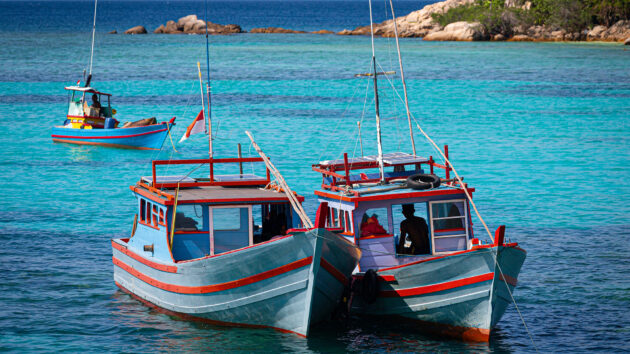
Vibrant Anambas fishing boats. Photograph: Jim Hooper
Wonderful Anambas
Arriving in Anambas after this 340-mile passage, what we discover is even higher than we imagined; the water is inviting; the seashores clear and villages dot the shore of only a handful of islands.
We head to the outer japanese islands first and work our method again west. It is a place with nothing a lot to do however snorkel and marvel on the pristine, protected anchorages we discover ourselves in.
One night at an bay often known as Moonrock we watch the complete moon rise whereas somebody performs saxophone on the seashore. It’s a troublesome place to wish to depart.
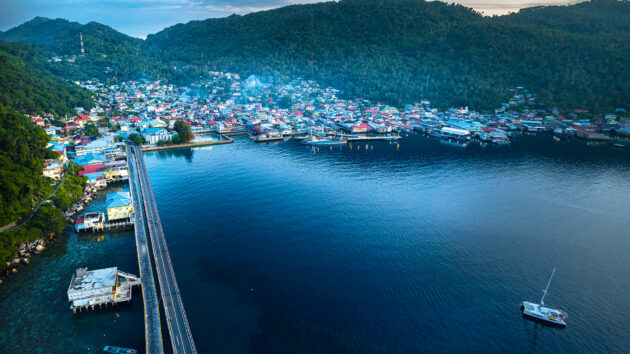
Siantan, one of many bigger islands within the Anambas Archipelago. Photograph: Jim Hooper
Ten months in and we’ve solely simply begun to get the cling of cruising this huge archipelagic nation.
It’s true there’s paperwork, and locations are so unfold out that – with two monsoon seasons – it’s simple to get caught ready for a climate window.
Secure locations to go away the boat with entry to airports for visa runs are few and much between, and importing spare elements are costly. However these hurdles pale compared to the unbelievable experiences we’ve had.
For the self-sufficient and adventurous, Indonesia affords hundreds of undeveloped, beautiful islands inhabited by exceptionally kind-hearted folks.
Kate Ashe Leonard has now sailed greater than 30,000 miles virtually seven years after transferring on board the Catana 47 Polaris along with her associate, Jim Hooper. They’re presently cruising Indonesia and within the coming yr they’ll proceed their circumnavigation west by means of the Indian Ocean. Observe on Instagram @sv_polaris and at svpolaris.com.
 In case you loved this text about cruising indonesia….
Yachting World is the world’s main journal for bluewater cruisers and offshore sailors. Each month we have now inspirational adventures and sensible options that can assist you realise your crusing goals.
Construct your data with a subscription delivered to your door. See our newest affords and save no less than 30% off the quilt worth.
Word: We could earn a fee while you purchase by means of hyperlinks on our web site, at no further price to you. This doesn’t have an effect on our editorial independence.
Source link


