

Impressed by house pirates and stealth plane, La Tortue 147 is a disruptive tackle long-distance cruising. François Tregouet sails the novel aluminium catamaran that turned a childhood dream into an engineering challenge and murals.
In a worldwide market, it’s a must to enchantment to the widest attainable viewers with a unanimously enticing design, which you’ll produce in massive portions to be aggressive. This looks as if unassailable logic. However at this 12 months’s Worldwide Multihull Present in La Grande Motte, it was an aluminium catamaran that disrupted this idea that attracted probably the most guests.
From curious onlookers to design and naval structure professionals, phrase unfold rapidly alongside the pontoons: La Tortue 147 was the boat to see.
La Tortue 147
Tortue creator Jean Sommereux on the (hexagonal) wheel of his design. Picture: JM Kalfon & A Childeric.
Whereas many shipyards current their newest improvements as a problem to the established order, this aluminium catamaran is the actual deal. Its rebellious design brings each type and sheer audacity.
Its creator, Jean Sommereux, has reworked a ship he dreamt of as a baby right into a extremely unique challenge temporary:
“A vessel as clever as house pirate Captain Harlock’s, extra playful than a Playmobil pirate ship, and with the look of a stealth bomber plane!”
Sommereux could have retained a childlike spirit, however he’s a seasoned entrepreneur with expertise in industrial welding, petrochemicals and aluminium furnishings.
This engineer’s thoughts can be delicate to aesthetics and artwork, so he designed La Tortue 147 together with his cousin, designer Jean-Michel Kalfon.
Kalfon is answerable for the distinctive ‘streaks’ on the home windows, that are ‘extra natural than organised’ in response to Sommereux, and impressed by Marseille’s Museum of European and Mediterranean Civilisations, designed by the sensible architect Rudy Ricciotti.
The inspiration behind La Tortue 147
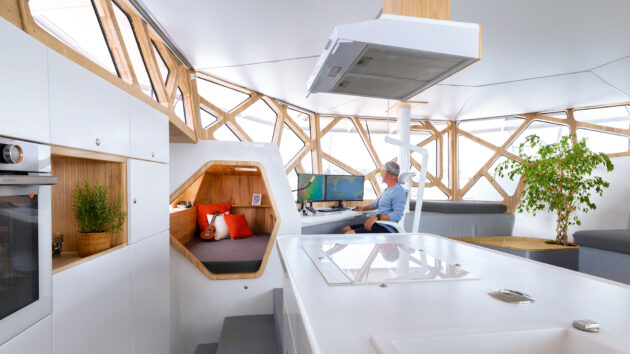
Latticework coachroof home windows give a see-through look to the saloon and permit pure gentle into the dwelling areas. The Picket latticework construction is manufactured from Paulownia, a quick rising plantation wooden that absorbs excessive ranges of CO2. Picture: JM Kalfon & A Childeric.
It was within the south of France, throughout a three-year voyage aboard an attractive 41ft schooner, that the concept for La Tortue 147 was born.
Sommereux did the maths: throughout his three years of wandering he had spent greater than 95% of his time at anchor.
“Which means I had the pot lid in my hand extra typically than the tiller,” he jokes.
This was the start line for La Tortue 147’s radical construct, an opulent idea of a cruising boat the place its creator would “reside above the water, with a espresso machine and a pc, actual inexperienced crops, a plancha grill, a fridge and, above all, my household, my associates and two or three good bottles of wine.”
The choice was made: the brand new boat can be not a hare however a tortoise, celebrating the true French artwork de vivre, or pleasure in dwelling.
“A ship that’s simple to deal with and accessible, in order that I can sail at 70 and even 80 years outdated with my spouse with out scaring ourselves, and the place we will welcome our kids… that’s the boat of my desires,” Sommereux explains.
To understand this dream, he arrange a shipyard from scratch in Hergla, a small coastal city within the Gulf of Hammamet in Tunisia: “In case you actually need to management your high quality requirements, it is advisable to have your individual shipyard,” he argues.
Constructing La Tortue 147
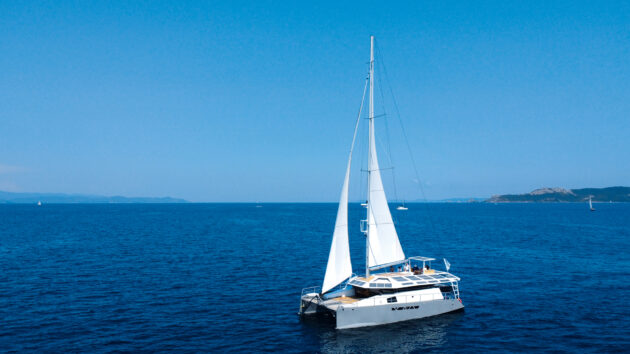
Picture: François Tregouet/MULTImedia.
Such an unique boat would even have been difficult to construct in a standard shipyard.
Whereas the design is disruptive, the development can be removed from unusual. Sommereux grew up close to the Meta shipyard, which constructed Bernard Moitessier’s legendary Joshua for the primary Golden Globe Problem in 1968.
So for him the selection of aluminium was a no brainer for a ship meant for long-distance cruising.
Influenced by Meta’s Strongall course of, many of the sheets are 8mm thick, whereas different builders are content material with 6mm.
Along with the plain benefit of influence resistance, this reduces the construction and subsequently the laborious factors, which ought to enable for smoother shapes.
Seeing the construction by the planking, as if it had been clear, is among the aesthetic criticisms typically levelled at aluminium boats.
For even larger security, the whole ahead part of the lodging space is 10mm thick. In complete, 10,800kg (23,810lb) of aluminium are used on La Tortue 147, representing 50% of the burden estimate.
As the utmost compression on the base of the mast has been calculated at 22 tonnes, the crossbeam has additionally been generously dimensioned, with a bit of 750 x 1,300mm.
Disruptive design
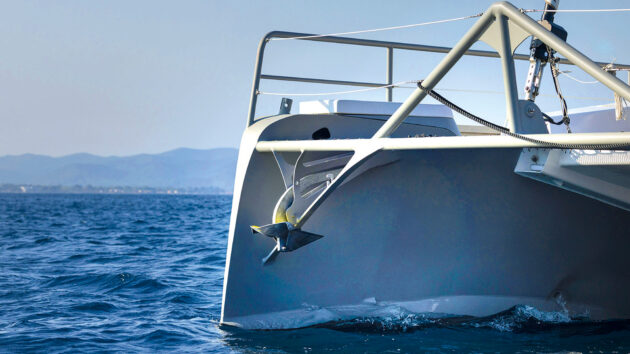
Elegant anchor stowage on the bow. Picture: JM Kalfon & A Childeric.
Moreover its development, the hull is way from typical in its traces, with bulges beneath the bows.
These improve the amount, permitting the engines to be positioned ahead of the central beam, optimising weight distribution at a time when the pattern is to maneuver them aft.
This might scale back the pitching actions which can be attribute and infrequently disagreeable in multihulls, although within the gentle winds we had been in a position to sail in I couldn’t check the idea.
The rear skirts are so long as they’re slender on the waterline and simply skim the floor of the water.
At sea, whether or not beneath engine or sail, the wake is minimal and silent. It’s a far cry from the washer swirls of some designs with their voluminous, large submerged sterns.
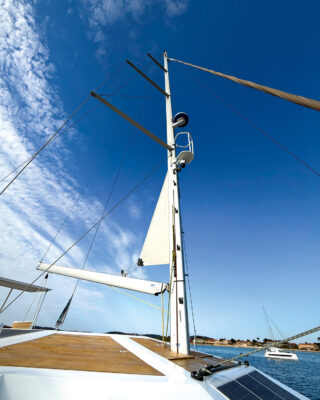
Three ranges of push-out spreaders, inner shrouds, working backstays – the unique rigging even features a crow’s nest! Picture: François Tregouet/MULTImedia.
The rigging may be very slender, with no roach on the mainsail, which furls up the mast.
The intention right here was to safe the rigging to the three ranges of spreaders hooked up to the stable central beam. This frees up the facet decks and avoids the necessity for mounted backstays on the stern.
The reasoning behind that is significantly extraordinary.
As a fan of motor paragliding, Jean wished to have the ability to take off from and land on the deckhouse of La Tortue 147.
Given the dangers of such manoeuvres his family and friends ultimately dissuaded him from attempting it, however the rigging remained as initially designed.
The identical goes for the inflexible flybridge bimini, which folds away to type what would have been the runway.
Onboard consolation, reimagined
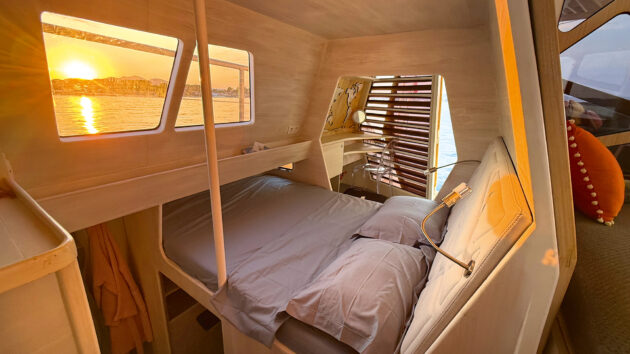
Grasp cabin has entry to each the transom and saloon, a dressing room beneath, a personal toilet and sea view. Picture: François Tregouet/MULTImedia.
A single step up gives entry to an initially thought-out inside house. On the port facet is a cloakroom-like space, you may go away your private belongings for the day inside simple attain in a locker – a superb thought.
Ahead, there’s direct entry to the galley. On the starboard facet, the grasp cabin with a transverse mattress has personal entry to the transom for morning swims.
Within the centre, the cockpit is sort of a nest suspended above the water. On one facet is a desk that may seat eight company, and on the opposite a plancha grill.
The only real is manufactured from Paulownia wooden.
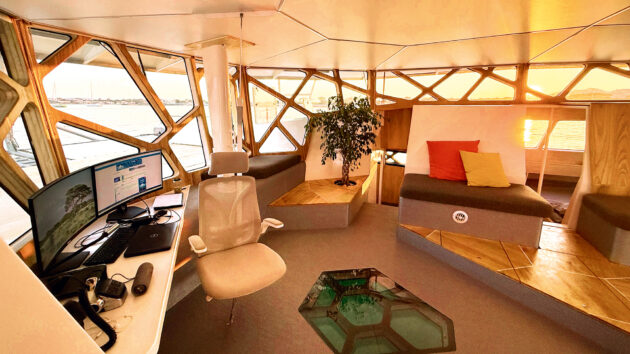
Heat tones and attention-grabbing gentle patterns created by the wooden and ‘shell’ sample window constructions. Picture: François Tregouet/MULTImedia.
The tortoiseshell patterns are very enticing, however this wooden – though environmentally pleasant – requires an excessive amount of upkeep outside and shall be changed, maybe with cork, on future fashions.
Inside, when you move by the central bay window, the identical wooden contributes to the boat’s total ‘wow’ impact.
Not solely is the amount spectacular, however the stripes additionally make an influence, Whereas the harmonious colors of the woodwork create a serene environment.
There are three ranges on this nacelle, which helps to outline the totally different areas.
The starboard bench is barely raised for a greater view, and its platform conceals loads of space for storing.
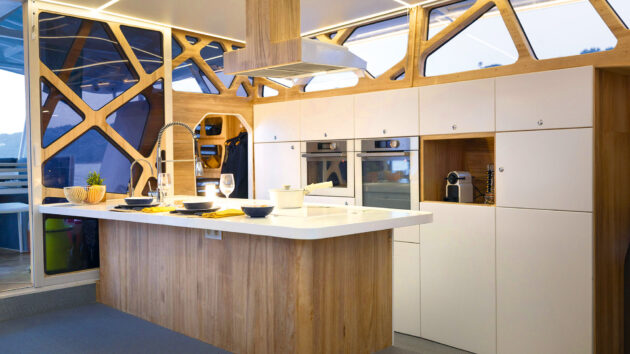
Galley is a full luxurious kitchen with an island worktop and many stowage house, headroom and pure gentle. Picture: JM Kalfon & A Childeric.
One facet of the lengthy (2.43m) galley worktop is ready again from a step, making it ergonomic in relation to the big portside storage unit. On the saloon facet, you may sit as if at a bar, or assist the cook dinner.
Ahead, the panoramic chart desk has a suspended seat straight out of an area shuttle.

Ahead berth on the port facet resembles a comfortable Alpine hut, with heat Paulownia wooden. Picture: François Tregouet/MULTImedia.
Nevertheless, a single opening porthole within the entrance window is a bit small for correct air flow in scorching climate – the boat is absolutely insulated with 40mm/1½in of XPS foam above the waterline.
Three additional cabins embody one nestled in an alcove on the deck on the entrance on the port facet, and one other additional aft, which share a central toilet. The final is on the entrance on the starboard facet, above the engine.
Carrying a load
The engines are situated on the bow, which requires comparatively lengthy propeller shafts, however these are effectively secured within the mounted keels. The engines are simply accessible through a deck panel from the big foredeck.
Nevertheless, accessibility will not be the robust level of the helm station situated on the rear of the deckhouse on the port facet.
The aluminium steps are a bit steep to descend rapidly, however there’s room to alter their configuration on future hulls.
In line with the tortoiseshell theme, the wheel is hexagonal fairly than spherical. Visibility is nice from the helm station, however to manoeuvre it’s a must to climb up onto the deckhouse – a flaw that, once more, could be corrected.
Coated with photo voltaic panels (5.5kW), this rooftop additionally incorporates a bench seat and a flybridge desk, beneath the retractable inflexible bimini high.
Lack of wind meant we had been unable to essentially check the crusing efficiency of this uncommon vessel, however with a sail space ratio of 10.5m² per ton of displacement (most catamarans sit between 8 and eight.5m²/t) it ought to be sprightly.
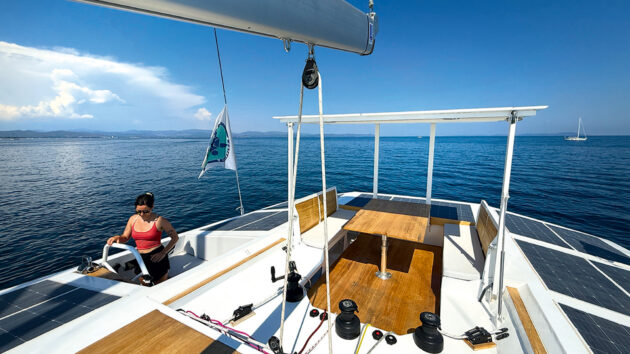
Surrounded by photo voltaic panels, the outer deck features a lounge space, helm station, a cockpit space, and a folding bimini. Picture: François Tregouet/MULTImedia.
However from the outset, the watchword for this round-the-world boat was that it had to have the ability to carry a load.
For autonomy, there’s tankage for 1,200lt/264gal of water, although there’s a watermaker, the identical of gas, and 20kVA of lithium batteries.
The boat will even carry loads of toys, from diving bottles to paddleboards.
La Tortue 147 has damaged the mould, however it stays to be seen whether or not crucial acclaim can translate right into a enterprise mannequin. Turning enthusiastic reception into gross sales is the problem dealing with the Cataruga crew.
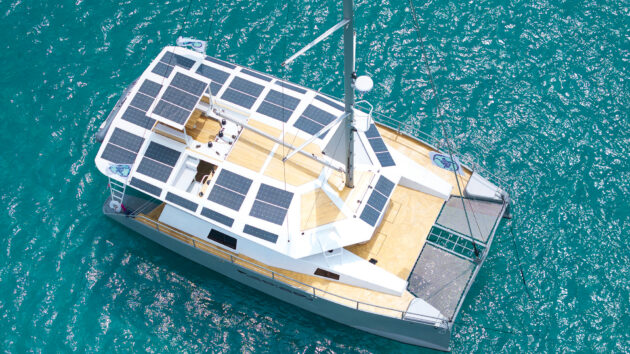
La Tortue boasts 5.5kW of photo voltaic panels on the saloon roof and bimini.
However, as with the catamaran of his desires, Jean Sommereux will not be in need of concepts – suggesting, for instance, the concept of a shared round-the-world journey.
We wouldn’t thoughts spending a couple of weeks on board crusing throughout the Pacific…
 In case you loved this text in regards to the aluminium catamaran La Tortue 147….
Yachting World is the world’s main journal for bluewater cruisers and offshore sailors. Each month we’ve got inspirational adventures and sensible options that can assist you realise your crusing desires.
Construct your information with a subscription delivered to your door. See our newest presents and save a minimum of 30% off the duvet value.
Observe: We could earn a fee whenever you purchase by hyperlinks on our website, at no further value to you. This doesn’t have an effect on our editorial independence.
Source link


