Water Quality, Biological Reality, and Systems That Degrade From the Inside
ENGINE ROOM → Auxiliary & Support Systems
System Group: Domestic Water Production & Waste Management
Primary Role: Provision of potable water and safe disposal of waste
Interfaces: Power Generation · Cooling Systems · HVAC · Crew Accommodation · Environmental Compliance
Operational Criticality: Continuous
Failure Consequence: Loss of habitability → health risk → operational restriction
Freshwater systems fail biologically long before they fail mechanically.
Position in the Plant
Freshwater, reverse osmosis, and sewage systems are often treated as hotel services. In reality, they define crew survivability, health, and operational endurance.
Unlike propulsion systems, failure here does not cause immediate alarms. It causes progressive degradation of living conditions, morale, and safety.
These systems are chemically and biologically active at all times.
Contents
System Purpose and Design Intent
Freshwater Production and Storage
Reverse Osmosis and Membrane Reality
Water Chemistry and Biological Growth
Distribution, Pressure, and Contamination
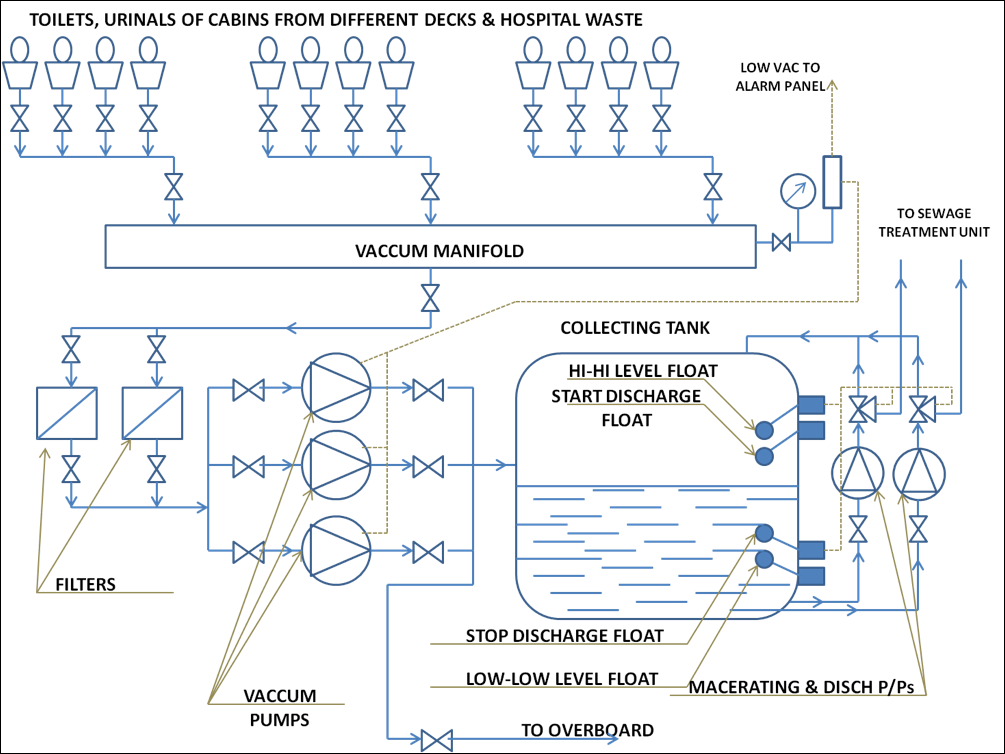
Sewage Systems and Treatment Constraints
Failure Development and Damage Progression
Human Oversight and Engineering Judgement
1. System Purpose and Design Intent
The design intent is safe, continuous water supply and waste disposal, not laboratory purity.
Freshwater systems must operate with:
- variable source quality
- fluctuating demand
- intermittent production
RO systems are designed to remove salts, not contamination introduced downstream.
Sewage systems are designed to contain and reduce waste, not make it disappear.
2. Freshwater Production and Storage
Freshwater is produced via evaporators or RO units and stored in tanks that are rarely sterile.
Stagnation promotes:
- bacterial growth
- biofilm formation
- corrosion under deposits
Tank coatings degrade. Sediment accumulates. Water quality deteriorates quietly.
Freshwater tanks are living systems, not inert vessels.
3. Reverse Osmosis, Pressure Control, and Membrane Reality
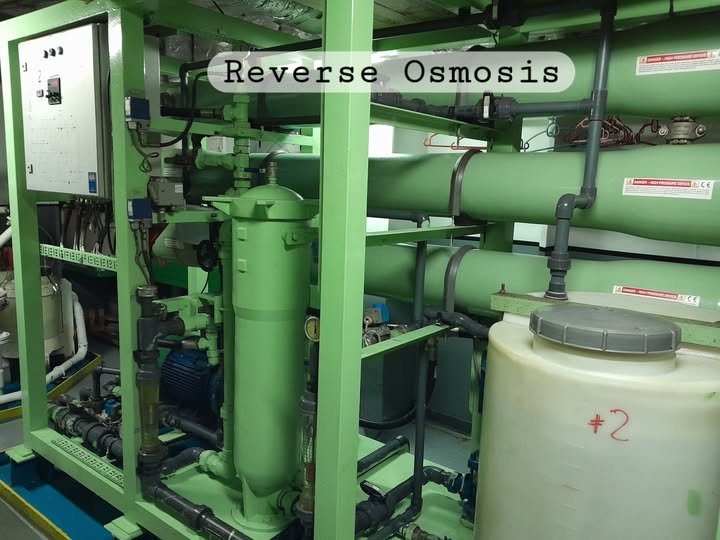
Reverse osmosis systems on board ship exist to convert an unlimited but hostile resource into a controlled and potable one. They achieve this by applying high pressure to seawater, forcing it across semi-permeable membranes that reject dissolved salts, microorganisms, and most organic contaminants. The result is fresh water suitable for domestic and operational use, and a concentrated brine stream returned overboard.
At its core, reverse osmosis is a reversal of a natural process. Under normal conditions, water migrates across a membrane from a low-salinity solution toward a higher-salinity one, driven by osmotic pressure. In an RO system, this process is inverted. Pressure greater than the natural osmotic pressure of seawater is applied to the saline side, driving water molecules through microscopic membrane pores while salts and larger impurities are retained.
This pressure requirement is not trivial. Marine RO plants rely on high-pressure pumps operating continuously near their design limits. Any instability in feed flow, temperature, or pressure propagates directly into membrane stress. For this reason, RO systems are mechanically simple but operationally unforgiving.
The membranes themselves are chemically selective and physically delicate. They are designed to pass water molecules while rejecting salts, bacteria, viruses, and larger dissolved solids. This selectivity depends on the integrity of the membrane surface and pore structure. Damage at a microscopic level immediately degrades product water quality long before total failure is obvious.
Pretreatment quality governs membrane life more than any other factor. Suspended solids, biological material, and hydrocarbons foul membrane surfaces, reducing permeability and increasing differential pressure. Chlorine and oxidising agents, commonly used elsewhere in shipboard water systems, chemically attack membrane materials and cause irreversible damage. Pressure shock during start-up, shutdown, or sudden valve movement induces mechanical stress that accelerates fatigue and delamination.
Membranes rarely fail catastrophically. They fail progressively. Freshwater output volume decreases, salinity creeps upward, and operating pressures rise as the system compensates. By the time alarms activate or taste complaints emerge, membrane performance has often been compromised for a considerable period.
From an operational perspective, reverse osmosis offers substantial advantages. It allows vessels to remain independent of shore water supplies, extending endurance and reducing logistical dependency. Eliminating the need to carry large volumes of potable water reduces weight, frees tank space, and lowers fuel consumption. On passenger vessels and offshore units, RO plants provide a consistent and scalable supply of water for drinking, cooking, washing, and hotel services without reliance on port infrastructure.
Environmental benefits are real but conditional. Reduced transport of bottled water lowers plastic waste and associated emissions, but only if RO systems are operated within design limits and maintained correctly. Poorly managed plants consume excessive energy, waste membranes prematurely, and produce reject streams that strain overboard discharge systems.
RO technology is now deployed across the full spectrum of vessel types, from yachts and workboats to cruise ships and offshore platforms. Modern installations are modular, allowing capacity to be matched to vessel size and demand. Advancements such as energy recovery devices, automated flushing sequences, and compact membrane housings have improved efficiency and maintainability, but they have not changed the fundamental sensitivity of the process.
Reverse osmosis systems are reliable when treated as precision equipment rather than utilities. They reward stable operation, disciplined pretreatment, and careful pressure control. When neglected or treated as fit-and-forget installations, they degrade quietly until water quality, crew confidence, and operational resilience are all compromised.
4. Water Chemistry, Storage Reality, and Biological Control
Storing water on board ship is not a passive activity. It is an ongoing chemical and biological process that must be actively controlled if potability, system integrity, and crew health are to be maintained.
Unlike shore-based installations, shipboard water systems operate in a confined, mobile environment where temperature, demand, and source quality fluctuate continuously. Tanks experience long retention times, distribution systems contain dead legs by necessity, and production sources vary between bunkered water and onboard desalination. In this environment, water chemistry becomes the primary control mechanism preventing biological growth and internal corrosion.
Biological activity is the dominant long-term threat. Bacteria, algae, and biofilm formation occur whenever conditions allow water to remain warm, stagnant, and insufficiently disinfected. Pathogens such as Legionella do not require gross contamination to proliferate; they thrive in marginal conditions that appear acceptable by visual inspection alone.
Stagnation is the most significant contributor. Low-flow zones in storage tanks, infrequently used pipe runs, and dead-end branches allow disinfectant residuals to decay while temperature stabilises at levels favourable to microbial growth. Once biofilms establish on internal surfaces, they provide a protected environment that shields microorganisms from chemical treatment and allows intermittent shedding back into the water stream.
Temperature accelerates this process. Warm water, particularly in tropical climates or in piping routed near machinery spaces, dramatically increases bacterial growth rates. Systems that oscillate between warm and tepid conditions — rather than remaining consistently cold or hot — are especially vulnerable.
Source water quality further complicates control. Bunkered water taken from ports or estuarine areas may contain elevated organic content and nutrients that fuel biological activity. Even water that meets shore-side standards can deteriorate rapidly once stored aboard if chemistry is not actively managed.
Disinfectant residual is therefore critical. Chlorine or equivalent biocides must be present throughout the distribution system, not just at the point of production or bunkering. A system that tests clean at the tank but carries no residual at distal outlets is already compromised. Without continuous disinfectant presence, microbial colonisation is a matter of time, not probability.
pH plays a dual role. It governs the effectiveness of disinfectants — chlorine efficacy drops sharply outside its optimal pH range — and it influences corrosion rates within tanks and pipework. Poor pH control accelerates both biological instability and material degradation.
Total dissolved solids, while often treated as a quality indicator rather than a control parameter, influence scale formation and treatment effectiveness. Elevated mineral content promotes internal deposition, creating roughened surfaces that encourage biofilm attachment and shield microorganisms from flow and disinfectant contact.
Managing these risks requires a layered approach combining physical, chemical, and operational controls.
Bunkering procedures form the first line of defence. Dedicated potable water hoses, clean connection points, and verification of source quality are essential to prevent contamination before water even enters the ship’s system. Once contaminated, remediation is far more complex than prevention.
Filtration removes suspended solids, organic matter, and larger microorganisms that would otherwise provide nutrients or attachment sites within tanks. Activated carbon filtration improves taste and odour but must be managed carefully, as carbon media can itself become a biological growth medium if neglected.
Disinfection is the primary control mechanism. Continuous chlorination maintains a residual that suppresses microbial growth throughout the system. Periodic shock chlorination — typically at significantly elevated concentrations for controlled durations — is used after maintenance or when contamination is suspected to sanitise tanks and distribution pipework. These procedures must be planned and executed carefully to avoid material damage while achieving biological control.
Onboard freshwater production through reverse osmosis or distillation removes salts, bacteria, and viruses, producing water that is chemically aggressive and biologically clean at the point of generation. However, this water is not inherently safe for storage or consumption. It must be remineralised for taste and material compatibility, then disinfected before entering storage tanks. Without this post-treatment, even the purest product water becomes biologically unstable once stored.
Ultraviolet sterilisation systems are increasingly used as secondary barriers, particularly at points of use such as galleys and medical spaces. UV does not provide residual protection, but it is highly effective at inactivating microorganisms immediately before consumption when upstream control cannot be fully guaranteed.
System design and maintenance determine long-term success. Minimising stagnation points, routinely flushing seldom-used outlets, cleaning showerheads and tap aerators, and physically inspecting tanks for corrosion or growth are essential practices. Chemical treatment alone cannot compensate for poor hydraulic design or neglected maintenance.
Continuous monitoring underpins all of this. Regular measurement of temperature, pH, disinfectant residual, and total dissolved solids provides early indication of instability. Periodic microbiological testing for indicators such as E. coli and Legionella validates that chemical control is effective in practice, not just in theory. Standards such as the WHO Guide to Ship Sanitation exist because experience has shown that visual clarity and taste are unreliable indicators of safety.
Shipboard water systems do not fail suddenly. They degrade biologically and chemically until a threshold is crossed — often marked by odour complaints, illness, or regulatory intervention. Engineers who treat stored water as a living system, rather than an inert utility, are the ones who prevent those failures.

5. Distribution, Pressure, and Contamination
Freshwater distribution systems experience pressure cycling, dead legs, and intermittent use.
These conditions favour bacterial growth.
Leaks introduce contamination inward, not outward.
Water that looks clear may be unsafe.
6. Sewage Systems and Treatment Constraints
Sewage systems rely on gravity, pressure, and biological processes.
Blockages, air locks, and pump failures are common.
Treatment units assume steady input. Variable use overwhelms biological stages.
Improper disposal creates odour, health risk, and regulatory exposure.
7. Failure Development and Damage Progression
Failures progress through:
- stagnation
- biological growth
- taste/odour complaints
- health risk
- system shutdown
Mechanical failure is usually secondary.
8. Human Oversight and Engineering Judgement
Engineers protect water systems by:
- preventing stagnation
- respecting chemical limits
- monitoring quality, not just pressure
A system delivering water is not necessarily delivering safe water.
Relationship to Adjacent Systems and Cascading Effects
Water system failures affect:
- crew health
- HVAC efficiency
- compliance
- operational endurance
These systems sustain life, not just comfort.