Load Sharing — When Generators Fight Each Other
Introduction — load sharing is where “healthy” systems quietly kill ships
Many vessels lose power without any generator actually failing. Engines run, fuel is clean, cooling is normal — yet the ship blacks out.
The cause is often poor load sharing.
When generators are paralleled, they must agree on:
- how much real power (kW) each carries
- how much reactive power (kVAr) each supplies
- how fast they respond to load changes
If they don’t, the PMS becomes a conflict amplifier.
What load sharing actually means onboard
Load sharing is split into two distinct control problems:
1️⃣ Real power sharing (kW)
Controlled by:
- engine governors
- droop or isochronous modes
- PMS supervisory logic
Poor kW sharing causes:
- one generator overload
- another underloaded
- trips that look “random”
2️⃣ Reactive power sharing (kVAr)
Controlled by:
- AVR droop settings
- excitation limits
- voltage setpoints
Poor kVAr sharing causes:
- voltage instability
- excitation saturation
- generator protection trips
- cascading collapse
ETO trap:
Crews monitor kW carefully and ignore kVAr until it’s too late.
Droop vs isochronous — not just theory
Droop control
- allows stable parallel operation
- generators share load proportionally
- frequency varies slightly with load
Isochronous control
- holds frequency constant
- requires one “master” unit
- unstable if misconfigured
Incorrect combinations (e.g. two isochronous governors online) cause:
- hunting
- load oscillation
- breaker trips
- blackout
This is not a tuning issue — it is a system design violation.
🔧 Regulatory anchors (explicit)
IEC 60092-201
Requires:
- stable power supply under normal operation
- suitable arrangements for parallel generators
SOLAS Chapter II-1, Regulation 42
Requires:
- sufficient power for propulsion and essential services
- ability to operate systems simultaneously
If load sharing causes a generator trip under normal load, the ship is not compliant in practice, even if compliant on paper.
🔻 Real-World Case: MV Viking Sky — Load Instability Before Generator Loss (2019)
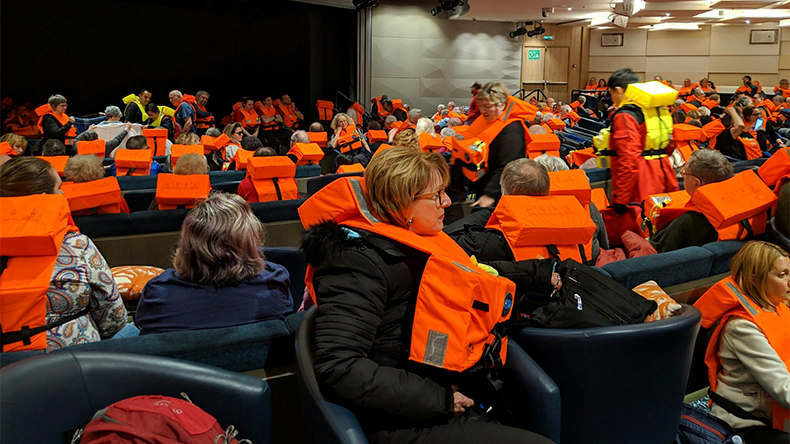
In the MV Viking Sky incident (Norway, March 2019), investigations showed that generator operation became unstable under heavy weather and dynamic load.
Key points:
- generators were running
- load conditions changed rapidly
- stability margins disappeared
- multiple units tripped sequentially
- propulsion was lost
While lubrication issues were the initiating factor, load sharing and recovery dynamics determined whether the ship survived.
ETO lesson:
Load sharing quality determines whether redundancy actually exists.
How load sharing fails in practice
Common onboard failure patterns:
- governor droop mismatches
- AVR droop incorrectly tuned
- PMS logic overridden for convenience
- generators paralleled outside design envelope
- no testing after maintenance
Load sharing problems rarely announce themselves clearly. They surface under stress, when correction time is minimal.
Professional ETO mindset
A competent ETO doesn’t ask:
- “Are all generators online?”
They ask:
- Are they sharing both kW and kVAr correctly?
- Which unit will trip first if load spikes?
- What happens if that unit trips right now?
Load sharing is not redundancy.
Correct load sharing creates redundancy.
Knowledge to Carry Forward
Parallel generators are cooperative systems. If they compete instead of cooperate, redundancy collapses into fragility.
A PMS that cannot share load smoothly under real operating conditions will eventually create a blackout — usually at the worst possible moment.
Tags
ETO, Power Management System, Load Sharing, Generator Paralleling, Viking Sky, Marine Blackout, IEC 60092, SOLAS II-1, Ship Electrical Stability