ENGINE ROOM → Control & Operations
Position in the Plant
System Group: Control & Operations
Primary Role: Continuous supervision, protection, and coordination of machinery
Interfaces: All propulsion, auxiliary, electrical, safety, and navigation systems
Operational Criticality: Absolute
Failure Consequence: Loss of situational awareness → delayed response → cascading machinery damage → loss of propulsion or blackout
Automation systems do not run ships.
They mediate between machinery reality and human decision-making.
Introduction
Modern ships are no longer operated directly.
They are observed, filtered, prioritised, and constrained by automation systems that decide what the crew is allowed to see, when they are warned, and how much time they have to act.
Integrated Automation Systems (IAS) and Alarm Monitoring Systems (AMS) are not convenience layers. They are the nervous system of the vessel. Every valve position, temperature trend, pressure decay, and electrical imbalance is interpreted through them.
When automation works well, machinery appears calm.
When it works badly, failures are invisible until they are irreversible.
Contents
- Purpose and Design Intent of Marine Automation
- IAS vs AMS – Functional Separation and Overlap
- System Architecture and Signal Hierarchy
- Control Modes, Authority, and Human Override
- Alarm Philosophy and Information Compression
- Automation Under Non-Design Conditions
- Failure Modes, Degradation, and False Stability
- Human Trust, Skill Fade, and Operational Risk
- Relationship to Shutdown, ESD, and Protection Systems
1. Purpose and Design Intent of Marine Automation
Marine automation exists to impose order on complexity.
A ship contains thousands of interacting processes operating at different time constants. Combustion responds in milliseconds. Cooling systems respond in minutes. Structural fatigue develops over years. No human operator can observe or process all of this in real time.
Automation systems therefore exist to:
- collect data continuously
- reduce it to meaningful parameters
- compare it against predefined limits
- initiate alarms, actions, or shutdowns
- present a simplified operational picture to the crew
Crucially, automation is not designed to optimise machinery life.
It is designed to prevent immediate damage and maintain availability within regulatory and commercial constraints.
Anything beyond that relies on engineering judgement.
2. IAS vs AMS – Functional Separation and Overlap
Although often bundled together, IAS and AMS serve different roles.
An Alarm Monitoring System (AMS) is fundamentally passive. It observes machinery parameters and raises alarms when thresholds are crossed. It does not normally control machinery directly.
An Integrated Automation System (IAS) extends this by issuing control commands, coordinating sequences, and enforcing interlocks. IAS systems start and stop machinery, manage load sharing, control valves, and execute predefined logic during transitions such as blackout recovery.
In practice, the boundary is blurred.
Most modern systems combine monitoring, control, logging, and protection into a single platform. The danger lies in assuming that because a system is “integrated”, it is also intelligent. It is not.
Automation executes logic exactly as written.
It does not understand intent.
3. System Architecture and Signal Hierarchy
Automation systems are structured hierarchically because complexity cannot be controlled in a flat system. Each layer exists to reduce raw physical behaviour into something that can be observed, compared, and acted upon. The price of this reduction is distance from reality.
At the lowest level sit field devices: sensors, transmitters, limit switches, solenoid valves, actuators, and local position feedback devices. These components interface directly with the physical plant. They are bolted to engines, embedded in pipework, exposed to vibration, thermal cycling, oil mist, humidity, salt air, and mechanical shock. They are the only part of the automation system that actually “touches” reality.
Field devices fail first, and they fail quietly.
Temperature elements drift due to thermal ageing. Pressure transmitters clog or develop offset due to contamination. Level sensors become unreliable as density changes or fouling accumulates. Actuators slow as seals harden or hydraulic oil degrades. None of these failures are dramatic. They manifest as believable but incorrect values.
Above the field level are local controllers, typically PLCs or distributed control units. These devices do not measure anything themselves. They interpret incoming signals, apply scaling and filtering, execute control loops, enforce interlocks, and generate commands for actuators. They also make decisions about what constitutes “normal” versus “abnormal”.
This is where signal conditioning occurs.
Noise is filtered. Values are averaged. Rate limits are applied. Deadbands are introduced to prevent oscillation. Each of these is necessary for stable control, but each also increases separation from instantaneous reality. A rapidly rising exhaust temperature may be smoothed into a gentle slope. A pressure spike may be entirely invisible if it falls outside the sampling window.
Controllers do not lie, but they simplify.
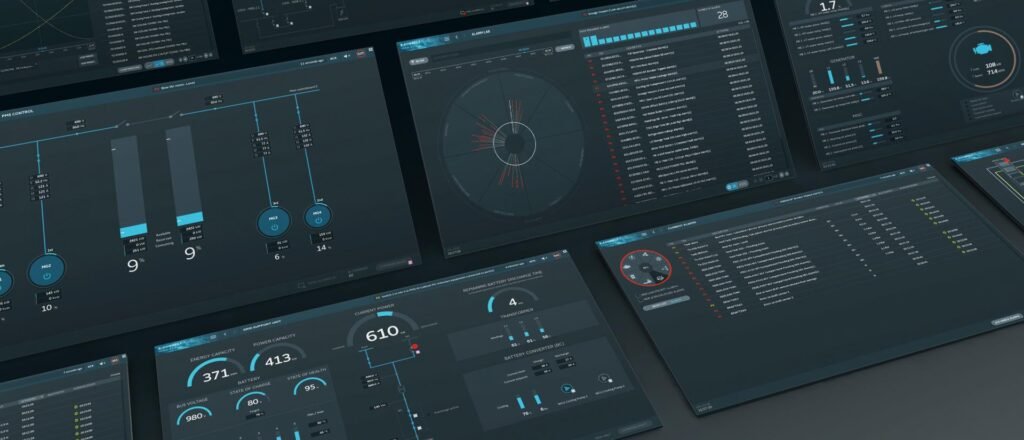
At the highest level sit the human–machine interfaces: control room consoles, mimic diagrams, alarm pages, trend displays, and data historians. These interfaces further compress information to fit human cognitive limits. Thousands of data points are reduced to colours, icons, and alarm priorities.
What the operator sees is not the plant.
It is a curated narrative about the plant.
This abstraction is deliberate. Without it, the system would be unusable. But it introduces a dangerous assumption: that what is displayed is both complete and current. In reality, every displayed value has passed through multiple transformations, each introducing latency and interpretation.
A temperature displayed on screen is not the temperature at the metal surface.
It is a calculated value derived from a sensor element, converted to an electrical signal, filtered by a transmitter, sampled by a controller, scaled in software, transmitted across a network, prioritised by logic, and finally rendered on a screen.
By the time the operator sees it, several seconds may have passed — and several decisions may already have been made by the automation system itself.
This hierarchy also defines failure visibility.
A failed sensor may appear as a stable value rather than an alarm. A controller fault may be masked by fallback logic. A network delay may freeze values without triggering alerts. Operators are therefore often reacting not to the onset of a fault, but to its secondary consequences elsewhere in the system.
Understanding automation architecture is therefore not an academic exercise. It is a diagnostic requirement.
When there is a discrepancy between what the system reports and what machinery behaviour suggests, the question is not “which is correct?” but where in the hierarchy the divergence was introduced.
Experienced engineers instinctively triangulate. They compare local gauges against screen values, listen for changes in machinery sound, observe actuator movement, and assess trend behaviour rather than single numbers. These habits exist because automation cannot be fully trusted without context.
Automation systems are powerful precisely because they abstract reality.
Engineering judgement is required because abstraction is never perfect.
4. Control Modes, Authority, and Human Override
Automation systems operate under defined control modes: local, remote, automatic, semi-automatic, or manual. These modes determine who has authority over machinery at any given moment.
Loss of clarity over control authority is a common precursor to incidents.
An operator may believe a pump is in manual when it is still subject to automatic stop logic. A valve may appear locally controlled while being overridden by an interlock elsewhere.
True manual control is rare on modern ships.
Most “manual” actions are still mediated by automation logic.
Human override exists, but it is deliberately constrained. This is a safety feature, not a flaw. The system assumes that humans are most likely to make errors under stress — precisely when overrides are attempted.
5. Alarm Philosophy and Information Compression
Alarms are not warnings.
They are attention demands.
A well-designed alarm philosophy ensures that only actionable information reaches the operator, prioritised by urgency and consequence. Poorly designed systems flood operators with alarms during abnormal conditions, exactly when clarity is most needed.
Alarm limits are often set conservatively, but not intelligently. They reflect regulatory minimums, manufacturer assumptions, and historical precedent rather than real operational margins.
The result is false stability: a system that remains “green” until it is already too late.
Engineers who rely solely on alarm states surrender early warning capability.
6. Automation Under Non-Design Conditions
Automation is designed around nominal operating envelopes.
Slow steaming, frequent manoeuvring, extended harbour operation, and degraded machinery all push systems outside these envelopes. Control loops hunt, alarms chatter, and logic sequences behave unpredictably.
Automation reacts to numbers.
It does not understand context.
A system that performs flawlessly at sea may become unstable alongside. This is not a software fault; it is a mismatch between design assumptions and reality.
7. Failure Modes, Degradation, and False Stability
Automation systems rarely fail catastrophically. They degrade.
Sensors drift. Impulse lines clog. Actuators slow. Communication delays increase. Alarms still trigger, but later than they should.
The most dangerous condition is not alarm activation — it is alarm absence.
A plant operating with permanently overridden alarms, suppressed alerts, or “known faulty” signals is blind by choice.
Automation hides deterioration by design.
Engineers must actively seek it.
8. Human Trust, Skill Fade, and Operational Risk
The more reliable automation appears, the less it is questioned.
Over time, crews adapt to screens rather than machinery. Manual skills fade. System understanding becomes procedural rather than conceptual.
When automation fails — or behaves unexpectedly — recovery is slow, not because of technical complexity, but because mental models no longer match reality.
Automation changes the nature of engineering work. It does not remove responsibility.
9. Relationship to Shutdown, ESD, and Protection Systems
Automation systems interface directly with shutdown logic and emergency stop systems. These are not advisory; they are authoritative.
Once invoked, shutdown systems prioritise machinery survival and regulatory compliance over availability. Automation will sacrifice propulsion, power, or cargo operations without hesitation.
Understanding how IAS, AMS, shutdown, and ESD systems interact is critical. They are not separate systems. They are layers of the same control philosophy, operating at different severity thresholds.
Closing Reality
Automation does not make ships safer by itself.
It makes them more complex.
Safety comes from engineers who understand what automation cannot see, cannot infer, and cannot judge.
A quiet control room is not proof of a healthy plant.
It is only proof that limits have not yet been crossed.