Royal Caribbean Orders Two More Icon-Class Megaships From Meyer Turku
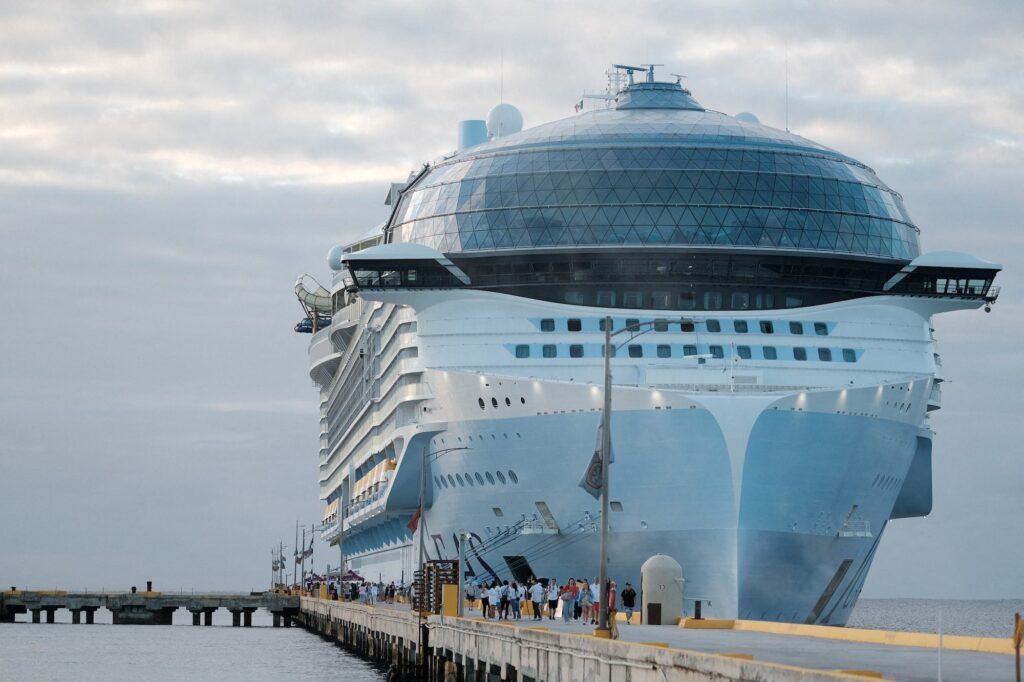
Tourists leave the Royal Caribbean’s Icon of the Seas, the largest cruise ship in the world, after arriving at Costa Maya Cruise Port, in the village town of Mahahual, Quintana Roo state, Mexico, February 6, 2024. REUTERS/Paola Chiomante/File Photo
Royal Caribbean Orders Two More Icon-Class Megaships From Meyer Turku
Mike Schuler
Total Views: 0
April 28, 2026
Royal Caribbean Group is doubling down on the world’s largest cruise ship class, confirming orders with Finnish shipbuilder Meyer Turku for a sixth and seventh Icon-class vessel to be delivered in 2029 and 2030.
The deal expands one of the cruise sector’s most significant shipbuilding programs and further extends Royal Caribbean’s long-term pipeline of megaship deliveries at a time when major cruise operators continue to lean into larger, more technologically advanced vessels despite
broader uncertainty
in global cruise-shipbuilding capacity.
The order falls under a long-term framework agreement securing Royal Caribbean access to
Trump Says Iran Wants Hormuz Open in Tussle Over War’s End
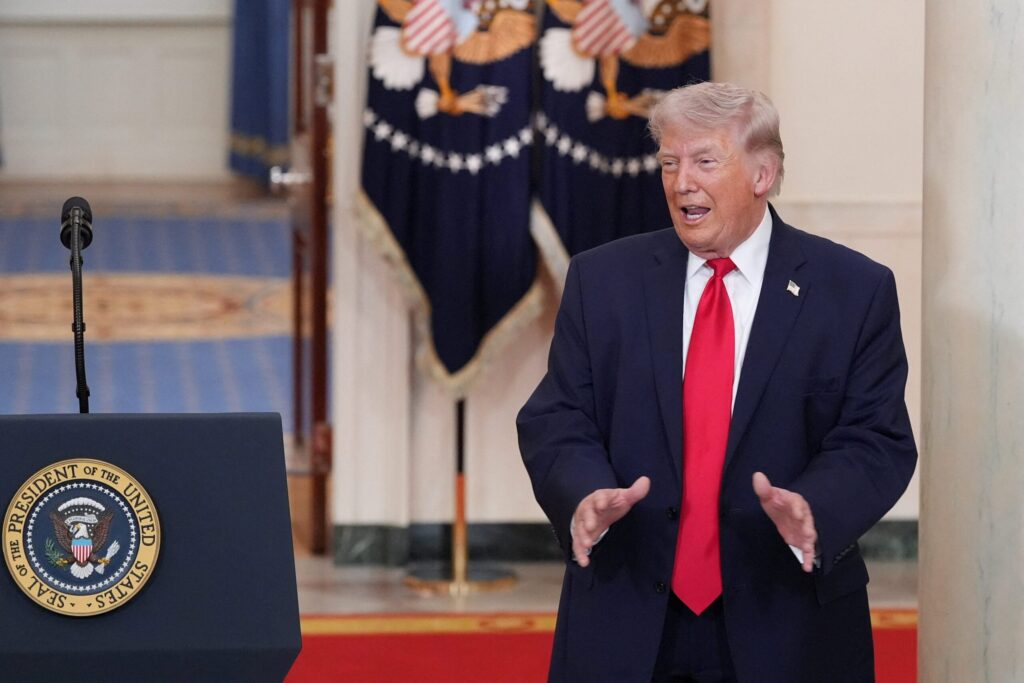
President Donald Trump gestures after delivering an address to the nation about the Iran war at the White House in Washington, D.C., U.S. Alex Brandon/Pool via REUTERS
Trump Says Iran Wants Hormuz Open in Tussle Over War’s End
Bloomberg
Total Views: 0
April 28, 2026
By Arsalan Shahla and Eltaf Najafizada (Bloomberg) — President Donald Trump said Iran has asked the US to lift a naval blockade of the
Strait of Hormuz
while the two sides negotiate an end to the two-month
war
, which has upended global energy supplies.
Tehran wants the critical waterway for oil and gas shipments open “as soon as possible, as they try to figure out their leadership situation,” Trump said on Truth Social on Tuesday. Iran has said it’s in a “State of Collapse,” he added.
The US leader on Monday convened his national security team to discuss an Iranian proposal to end the conflict, which began with US and Israeli airstrikes on the Islamic Republic on Feb.
Iran’s Guards Seize Wartime Power, Blunting Supreme Leader’s Role

FILE PHOTO: Members of Iran’s Revolutionary Guards participate in a military parade to commemorate the anniversary of the start of the 1980-1988 Iran-Iraq war, in Tehran September 21, 2008. REUTERS/Caren Firouz (IRAN)/File Photo
Iran’s Guards Seize Wartime Power, Blunting Supreme Leader’s Role
Reuters
Total Views: 0
April 28, 2026
DUBAI, April 28 (Reuters) – Two months into a
war
with the U.S. and Israel, Iran no longer has a single, undisputed clerical arbiter at the pinnacle of power — an abrupt break with the past that may be hardening Tehran’s stance as it weighs renewed talks with Washington.
Since its creation in 1979, the Islamic Republic has revolved around a supreme leader with final authority on all key matters of state.
UAE Quits OPEC in Major Blow to Global Oil Producers’ Group
The logo of the Organization of the Petroleum Exporting Countries (OPEC) is seen inside its headquarters in Vienna, Austria, December 7, 2018. REUTERS/Leonhard Foeger
UAE Quits OPEC in Major Blow to Global Oil Producers’ Group
Reuters
Total Views: 4
April 28, 2026
By Maha El Dahan
DUBAI, April 28 (Reuters) – The United Arab Emirates said on Tuesday it was quitting OPEC, dealing a heavy blow to the oil producers’ group as an unprecedented energy crisis triggered by the
Iran war
exposes discord among Gulf nations.
The loss of the UAE, a longstanding OPEC member, could weaken the group, which has usually sought to show a united front despite internal disagreements over geopolitics and production quotas.
UAE Energy Minister Suhail Mohamed al-Mazrouei told Reuters the decision was taken after a careful look at the regional power’s energy strategies.
Asked whether the UAE consulted with OPEC’s de facto leader and regional heavyweight Saudi Arabia, he said the UAE did not raise the issue with
Reliability You Can See: Why Ocean Freight Decisions Fail Without Performance Intelligence

Reliability You Can See: Why Ocean Freight Decisions Fail Without Performance Intelligence
in
International Shipping News
27/04/2026
Most ocean freight decisions still look robust at the moment they are made. Procurement teams benchmark rates, compare carrier offers, and award contracts based on a mix of price and service promises. But when the market moves, as it so often does, Logistics and Operations are left inheriting the mess.
Korea’s Big Three Race to Build Ammonia-powered Ships
Korea’s Big Three Race to Build Ammonia-powered Ships
in
Shipbuilding News
27/04/2026
As environmental regulations driven by the climate crisis put pressure on the entire shipbuilding and shipping industry, the domestic shipbuilding sector is accelerating the development of ships using ammonia, considered a carbon-free fuel.
According to a report published by the Korean Register (KR) on April 23, the shipping sector accounts for approximately 2.9% of global carbon emissions.
The International Maritime Organization (IMO) adopted its Initial GHG Reduction Strategy in 2018, setting a goal to halve carbon emissions from shipping by 2050. The European Union (EU) has also been directly imposing the cost of carbon emissions by including the shipping sector in its Emissions Trading System (ETS) starting from 2024.
Amid these changes in the policy environment, shipping companies are treating greenhouse gas reduction and the development of eco-friendly ships as a necessity, not a choice, and are
What happens if your FuelEU pool fails? The execution risk under FuelEU Maritime
What happens if your FuelEU pool fails? The execution risk under FuelEU Maritime
in
International Shipping News
27/04/2026
Today, pooling is widely recognised as a reliable compliance mechanism under FuelEU Maritime. In most commercial discussions, the underlying assumption is that once a pool is agreed, it will be executed. This assumption deserves closer investigation.
In practice, pooling is not a single step but a multi-stage process with dependencies and hard deadlines.
Global maritime climate technology market exceeds NOK 400 billion: Norway among leading suppliers
Global maritime climate technology market exceeds NOK 400 billion: Norway among leading suppliers
in
International Shipping News
27/04/2026
A new report shows that the global market for maritime climate technology has already surpassed NOK 400 billion, highlighting significant opportunities for suppliers worldwide as the shipping industry accelerates its transition to low- and zero-emission solutions.
The report, Maritime Climate Technology – Norwegian Positions in Global Markets, has been developed by Menon Economics and Maritime CleanTech on behalf of Innovation Norway. It provides one of the first comprehensive estimates of the global market and maps the position of Norwegian suppliers within it.
“We have good reason to be proud of the findings in this report. The fact that Norway holds such a significant market share demonstrates the strength of our maritime climate technology capabilities.
Indonesia’s toll remarks for Malacca Strait draws attention to choke point risks
Indonesia’s toll remarks for Malacca Strait draws attention to choke point risks
in
International Shipping News
27/04/2026
Indonesia’s Finance Minister has floated the idea of imposing a levy on ships transiting the Strait of Malacca, following Singapore Deputy Prime Minister’s statement on ships’ unconditional transit rights through international straits April 21.
Finance Minister Purbaya Sadewa said April 22 at a symposium in Jakarta: “As the President said, Indonesia is not a peripheral country. We are on a strategic global trade and energy route. Yet ships passing through our straits are not charged.
2026 Vessel Speed Reduction Season Kicked off on Earth Day
apphire award winning shipping lines recognized at the ceremony; Credit: Adam Ernster
2026 Vessel Speed Reduction Season Kicked off on Earth Day
Sponsored
Total Views: 6
April 27, 2026
Industry Leadership Celebrated by Blue Whales and Blue Skies Program
Earth Day marked several important milestones for California’s coast, benefiting both coastal counties and marine life. On April 22, Blue Whales and Blue Skies (BWBS) launched the 2026 voluntary Vessel Speed Reduction (VSR) Season, now along the entire California coast as set forth in California Assembly Bill 14, authored by Assemblymember Gregg Hart and signed into law by Governor Gavin Newsom last year.
The season kickoff also featured an in-person gathering near the Port of Oakland for the annual BWBS Awards Ceremony. Industry, public agencies, and nonprofit leaders gathered to recognize shipping lines’ verified efforts in responsible shipping over the course of the 2025 Season.