Hormuz closure drives record tanker rates, boosts Teekay earnings
Hormuz closure drives record tanker rates, boosts Teekay earnings
in
International Shipping News
18/05/2026
The effective closure of the Strait of Hormuz and the loosening of Venezuelan crude flows propelled midsize tanker rates to among the highest levels on record, Teekay Tankers executives told investors May 14, crediting the geopolitical environment for a surge in first-quarter earnings.
Teekay Tankers reported first-quarter 2026 net income of $153.6 million, or $4.42 per share, roughly double the $76 million it earned a year earlier. Adjusted net income was $128.3 million, or $3.69 per share, compared with $41.8 million a year earlier.
The owner of 33 oil and product tankers said Suezmax and Aframax/LR2 spot rates averaged $61,000/day in Q1, with Suezmaxes earning $62,124/day and Aframax/LR2s $59,934/day. Quarter-to-date Q2 rates have climbed further, with Suezmaxes booked at $121,800/day on 60% of available days, Aframax/LR2s at $98,000/day on 53%, and the company’s lone VLCC at
Five Weeks Into the Ceasefire, Hormuz Is Operating Under Control

Five Weeks Into the Ceasefire, Hormuz Is Operating Under Control
in
International Shipping News
18/05/2026
Operational Overview
Five weeks into the ceasefire, the Strait of Hormuz remains constrained, opaque, and increasingly managed through selective access.
The clearest signal is the state of Iranian export infrastructure. Kharg Island showed no active tanker loading for multiple consecutive days, while large tanker queues remained staged nearby. No confirmed crude departures have been observed from Kharg since May 7, and imagery indicates continued repair activity near damaged western infrastructure.
Global LPG flows on the road to recovery
Global LPG flows on the road to recovery
in
International Shipping News
18/05/2026
Global seaborne LPG exports have recovered back toward the five-year average in May after a sharp disruption due the Middle East Gulf conflict and the strait of Hormuz closure, with flows rebounding to around 4.8mbd on a 28-day moving average basis.
Though this recovery is positive for import starved Asian buyers, the world continues to be short by ~600kbd compared to the historically high levels observed in February 2026. The recovery has been led predominantly by the US, which remains the largest seaborne LPG exporter globally. Other suppliers stepping up include Algeria, Canada, Malaysia, Sweden and Argentina in volumetric order.
Global seaborne LPG exports (bd, 28-day moving average)
Imports should also recover from here on
Global seaborne LPG imports also weakened sharply through April, mirroring the collapse in export volumes.
DP World, Syria’s GABC Discuss Accelerating Port Of Tartous Development Plans

DP World, Syria’s GABC Discuss Accelerating Port Of Tartous Development Plans
in
Port News
18/05/2026
His Excellency Essa Kazim, Chairman of DP World, met His Excellency Qutaiba Ahmed Badawi, Chairman of Syria’s General Authority for Borders and Customs (GABC), and discussed the latest progress on the Port of Tartous development. The project highlights the port’s role as a strategic maritime gateway that supports Syria’s economic recovery and boosts trade activity.
The meeting in the Syrian capital, Damascus, discussed opportunities for enhancing infrastructure and logistics efficiency to ensure the Port of Tartous is well equipped to handle the anticipated rise in trade and cargo volume. Such efforts aim to underline the Port’s status as a key regional gateway linking trade routes across Southern Europe, the Middle East and North Africa.
DP World’s plans to develop the Port of Tartous form part of a 30-year concession agreement signed in July 2025 with the Syrian government.
India’s crude oil purchase from Russia drops more than 15%
India’s crude oil purchase from Russia drops more than 15%
in
Freight News
18/05/2026
India’s crude oil purchases from Russia dropped over 15% in April after the country’s buyer shut the refinery for routine maintenance, European think tank Centre for Research on Energy and Clean Air (CREA) said in a report.
India imported Euro 4.5 billion worth of crude oil (raw material for making fuels like petrol and diesel) from Russia in April, down from Euro 5.3 billion worth of imports in the preceding month.
CREA said India was the second-largest buyer of Russian fossil fuels in April 2026, importing a total of Euro 5 billion of Russian hydrocarbons.
“Crude oil constituted 90% of India’s purchases, totalling Euro 4.5 billion. Coal (Euro 297 million) and oil products (EUR 209 million) constituted the remainder of their monthly imports,” it said.
In March, India imported a total of Euro 5.8 billion of Russian hydrocarbons. That month, crude oil products constituted 91% of India’s purchases, tota
Georgia’s Never, Never Port
Georgia’s Never, Never Port
in
Port News
18/05/2026
Conceived as a strategic gateway linking Europe to the Black Sea and onward to Central Asia, Anaklia deep sea port was meant to anchor Georgia’s central role in the transcontinental trade routes of the future. Instead, it has been snared in a web of domestic politics, opaque decision-making, and growing pressure from Russia and China.
From time to time, Anaklia still makes headlines. Georgia’s prime minister says construction is about to resume, the Chinese ambassador mentions it, a government minister travels to Beijing promising positive news, only for there to be further concerns about the Georgian Dream government’s strategic ambiguity.
Tbilisi constantly makes familiar reassurances: progress is coming, decisions are near, the port will be built.
Iran to unveil Strait of Hormuz traffic plans, will collect tolls
Iran to unveil Strait of Hormuz traffic plans, will collect tolls
in
International Shipping News
18/05/2026
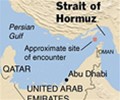
Iran has prepared a mechanism to manage traffic through the Strait of Hormuz and plans to collect fees in the waterway, head of the Iranian parliament’s national security committee Ebrahim Azizi said on Saturday.
“Iran… has prepared a professional mechanism to manage traffic in the Strait of Hormuz along a designated route,” Azizi said in a social media post, adding that the plan will be “unveiled soon.”
Azizi said “necessary fees” will be collected under the mechanism, and that only commercial vessels and “parties cooperating with Iran” will “benefit” from the measure.
“This route will remain closed to the operators of the so‑called “freedom project,” Azizi said, likely referring to U.S. President Donald Trump’s “Project Freedom,” which was aimed at restoring commercial shipping in Hormuz. Trump had abruptly paused the operation earlier in May.
Separately, Iranian state TV claim
Maritime to take 15% of clean hydrogen demand by 2060, DNV forecasts
Maritime to take 15% of clean hydrogen demand by 2060, DNV forecasts
in
International Shipping News
18/05/2026
Clean hydrogen uptake is expected to be the third strongest in the maritime sector, according to DNV’s latest hydrogen outlook.
The report notes that renewable and low-carbon hydrogen remain key to decarbonizing hard-to-electrify industries, such as shipping and aviation.
DNV said clean hydrogen will replace 65 million tonnes of unabated hydrogen use and be used in synthetic fuels for the aviation and maritime sectors.
“The addressable market for clean hydrogen and its derivatives is now more focused on those areas of energy demand that are impossible to electrify,” said Ditlev Engel, CEO of Energy Systems at DNV, adding that maritime applications are expected to use hydrogen derivatives in the form of ammonia and e-methanol.
According to the report, these hydrogen-derived fuels will help reduce dependence on oil in aviation and maritime transport, sectors that are central to
LNG Spot Market Flat, As LPGs Keep Rising
LNG Spot Market Flat, As LPGs Keep Rising
in
International Shipping News
18/05/2026
LNG
The LNG spot market remained relatively flat this week, with balanced tonnage and enquiry across both basins keeping sentiment steady.
On the BLNG1 Australia–Japan route, 174k cbm vessels eased $1,700 week-on-week to settle at $64,800/day, as muted Pacific activity and a balanced tonnage list kept the market steady but under slight pressure.
The BLNG2 US Gulf–Continent route softened marginally, with earnings slipping $800 to $94,300/day. Despite limited vessel availability in the Atlantic, a lack of fresh cargoes prevented any meaningful upside momentum.
Similarly, the BLNG3 US Gulf–Japan route declined $5,300 to $100,800/day, with less long-haul enquiry due to a weaker arb.
In the time charter market, period rates were mixed. The six-month rate edged up $200 to $92,300/day, while the one-year term fell $1,600 to $85,100/day.
Russia Expands LNG Dark Fleet With Four Tankers to Boost Exports
(Source: morflot.gov.ru)
Russia Expands LNG Dark Fleet With Four Tankers to Boost Exports
Bloomberg
Total Views: 0
May 18, 2026
By Stephen Stapczynski
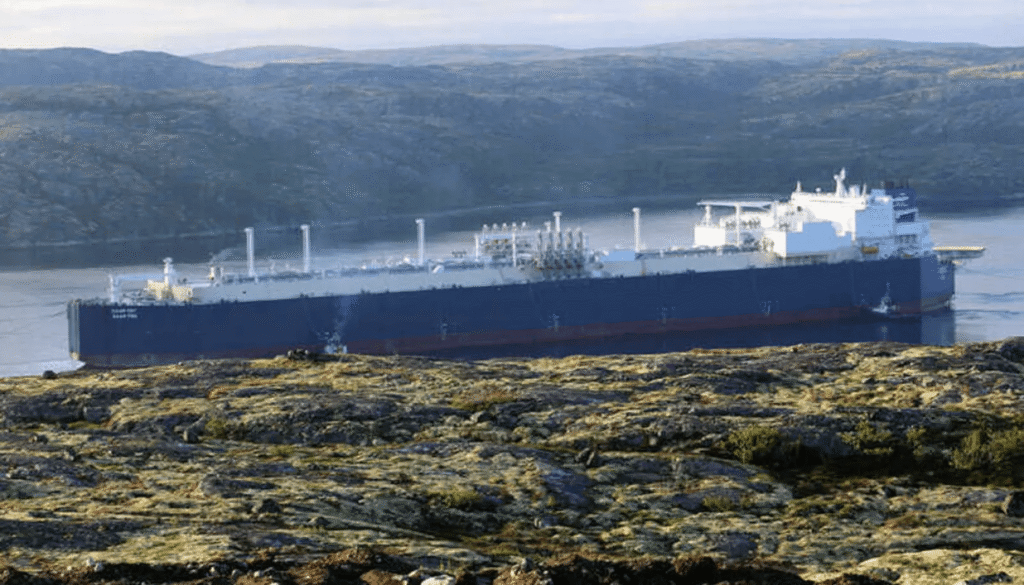
May 18, 2026 (Bloomberg) –Four liquefied natural gas tankers that until recently serviced Oman’s export plant are beginning to load fuel from a US-sanctioned Russian project, the latest sign of Moscow’s efforts to boost shipments and skirt Western restrictions.
The
Kosmos
docked over the weekend alongside the blacklisted Saam floating storage unit near Murmansk in western Russia before later departing with a deeper draft, a sign that it had taken on a cargo, according to ship-tracking data. Three other former Omani vessels —
Merkuriy, Orion and Luch
— have also picked up from Saam or are positioning to dock there, ship data shows.
Saam stores fuel produced by the US-sanctioned Arctic LNG 2 plant, which is only accessible to vessels with ice-breaking capability for most of the year. Shipping is the key bottleneck for Russia’s fuel trapped