One Week Into the Ceasefire: A Maritime Intelligence Breakdown

One Week Into the Ceasefire: A Maritime Intelligence Breakdown
in
International Shipping News
17/04/2026
One week after the ceasefire was announced, the maritime system has not returned to open navigation. Instead, the ceasefire has introduced a more complex operating environment, with continued vessel movement but no consistent framework for access or navigation.
In the immediate aftermath of the announcement, transit through the Strait of Hormuz continued, but only under the same IRGC-controlled structure that had been in place since mid-March. Routing remained confined to alternative corridors through or alongside Iranian territorial waters, approval was still required, and vessels were explicitly warned that unauthorized transit could be targeted.
As the week progressed, it became clear that this was not a reopening, but a supervised pause.
U.S. Coast Guard to Homeport First Two Arctic Security Cutters in Alaska
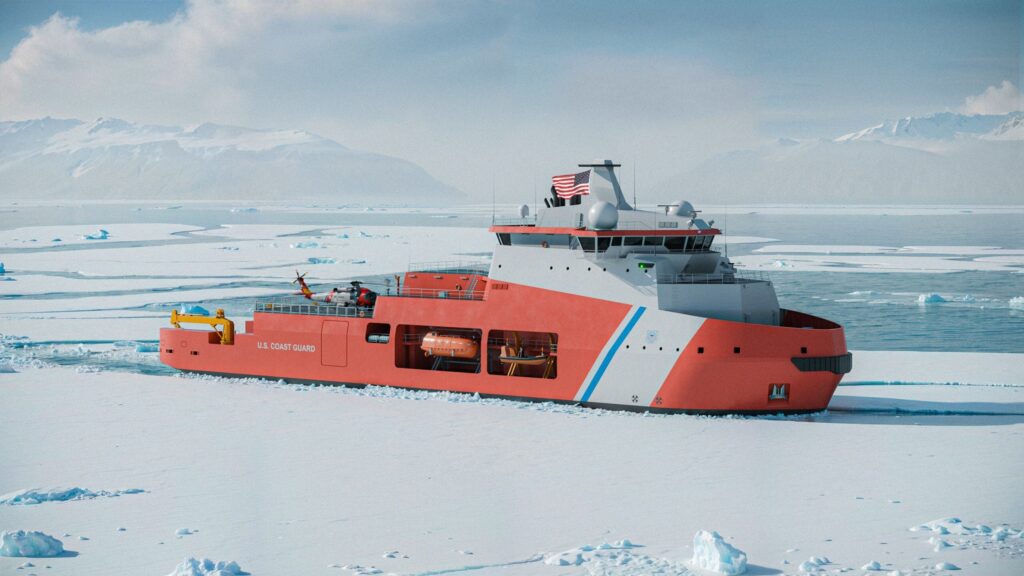
A rendering of a future Arctic Security Cutter awarded to Davie Defense, part of the U.S. Coast Guard’s expanded icebreaker fleet, operating in polar waters as Washington moves to close the U.S. Coast Guard to Homeport First Two Arctic Security Cutters in Alaska
Mike Schuler
Total Views: 1
April 16, 2026
The U.S.
Tankers: India Emerging As a Leading Market for Seaborne Crude Oil Imports
Tankers: India Emerging As a Leading Market for Seaborne Crude Oil Imports
in
Hellenic Shipping News
17/04/2026
C
rude tankers carrying oil into India have been in high demand since the start of 2026. In its latest weekly report, shipbroker Banchero Costa said that “after a modest upturn in 2024, when global crude oil loadings increased by +0.8% y-o-y, things picked up further in 2025, with full-year volumes increasing by +2.0% y-o-y. In Jan-Feb 2026, global crude oil loadings increased by +6.3% y-o-y to 362.5 mln tonnes, excluding all cabotage trade, according to vessels tracking data from LSEG.
UN: Middle East conflict chokes end of supply chain as lights go out in the Pacific
UN: Middle East conflict chokes end of supply chain as lights go out in the Pacific
in
International Shipping News
17/04/2026
For Pacific Island countries, the Middle East crisis is not a distant geopolitical event. It is already showing up in higher fuel prices, electricity uncertainty and fears that communities sitting at the far end of global supply chains could be pushed into deeper economic insecurity.
“We are at the end of the supply chain,” Tuya Altangerel, a senior UN Development Programme (UNDP) official in the Pacific region, told UN News “so this energy crisis is really impacting our communities.”
With Fiji a significant hub in the Pacific Ocean, island nations that surround it extend thousands of miles into the world’s largest ocean, with the distance between some islands as much 3,000 miles.
Within this vast area, the isolation from the rest of the world is not only very challenging by also expensive.
From Fiji to Tuvalu, the Solomon Islands to the Marshall Islands, govern
Pakistan Oil Tanker Makes Rare Entry and Exit Through Hormuz
FILE PHOTO: Tankers sail in the Gulf, near the Strait of Hormuz, as seen from northern Ras al-Khaimah, near the border with Oman’s Musandam governance, amid the U.S.-Israeli conflict with Iran, in United Arab Emirates, March 11, 2026. REUTERS/Stringer//File Photo
Pakistan Oil Tanker Makes Rare Entry and Exit Through Hormuz
Bloomberg
Total Views: 0
April 17, 2026
By Weilun Soon
Apr 17, 2026 (Bloomberg) –A Pakistan-flagged tanker that entered the Persian Gulf over the weekend has become the first carrier to exit through the Strait of Hormuz with a crude cargo since a US blockade began on Monday, underscoring just how limited traffic through the vital chokepoint remains.
The
Shalamar
sailed just south of Iran’s Larak island and out into the Gulf of Oman late Thursday with around 450,000 barrels of crude loaded at Das Island in the United Arab Emirates, according to ship-tracking data. The Aframax tanker, only half full, is signaling Karachi as its destination.
Transits through the narrow
European Countries Have Capacity to Clear Mines in Hormuz, French Defence Minister Says
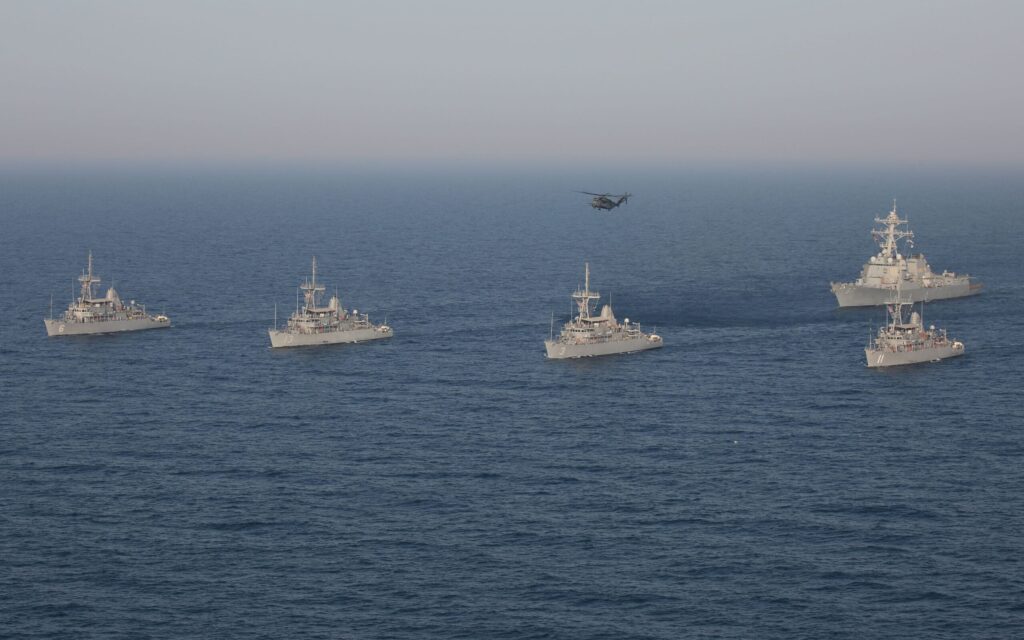
FILE PHOTO: A formation of Avenger-class mine countermeasure ships USS Devastator (MCM 6), USS Gladiator (MCM 11), USS Sentry (MCM 3), USS Dextrous (MCM 13), the Arleigh Burke-class guided missile destroyer USS Mason (DDG 87) and an MH-53E Sea Dragon helicopter assigned to the “Blackhawks” of Helicopter Mine Countermeasures Squadron (HSM) 15 maneuver in the Arabian Sea, July 6, 2019. Navy/Handout via REUTERS ATTENTION EDITORS- THIS IMAGE HAS BEEN SUPPLIED BY A THIRD PARTY./File Photo
European Countries Have Capacity to Clear Mines in Hormuz, French Defence Minister Says
Reuters
Total Views: 0
April 17, 2026
PARIS, April 17 (Reuters) – European countries such as Belgium, the Netherlands and France have mine clearance capacity which could help secure passage through the Strait of Hormuz, French Defence Minister Catherine Vautrin told French TV station TF1 on Friday.
“There are capabilities to provide fully supported escort services – that is to say, in no way offensive, of course – for s
Intenational shipping under threat from blockade
Intenational shipping under threat from blockade
in
International Shipping News
17/04/2026
Disruptions in and around the Strait of Hormuz threaten to further slow international shipments after US-Iran talks failed and Washington imposed a blockade on traffic entering or leaving Iranian ports, shipping experts said.
The US military’s blockade of ships “entering or departing Iranian ports and coastal areas” in the Strait of Hormuz located between Iran and Oman took effect on Monday. The Strait links the Gulf north of it with the Gulf of Oman to the south and the Arabian Sea beyond.
No vessels have made it past US naval forces during the first 48 hours of the blockade, according to US Central Command. Even so, US President Donald Trump said the war in Iran was “very close to over” in an interview that aired on Wednesday, The Associated Press reported.
The AP reported that the commander of Iran’s joint military command on Wednesday threatened to halt trade in the Gulf region if the US does
Hazardous cargo compensation regime moves to entry into force
Hazardous cargo compensation regime moves to entry into force
in
International Shipping News
17/04/2026
Belgium, Germany, the Kingdom of Netherlands and Sweden deposit ratifications to 2010 HNS Convention.
Four States deposited their instruments of ratification of the International Convention on Liability and Compensation for Damage in Connection with the Carriage of Hazardous and Noxious Substances by Sea, 2010 (2010 HNS Convention), bringing the treaty’s entry into force a step closer.
The 2010 HNS Convention aims to ensure adequate, prompt, and effective compensation for those affected by incidents involving hazardous and noxious substances (HNS) carried on seagoing ships. This is particularly relevant given the increasing amounts of chemicals and alternative fuels being transported in bulk by sea.
There are now 12 Contracting States* to the 2010 Protocol to the HNS Convention, meeting the number of States criteria for entry into force. The treaty requires at least 12 States to expr
The world’s first global carbon price back on the negotiating table at the UN
The world’s first global carbon price back on the negotiating table at the UN
in
International Shipping News
17/04/2026
Governments are resuming negotiations at the UN on the Net-Zero Framework (NZF) for international shipping, a landmark climate agreement introducing the world’s first global carbon price on any polluter.
The talks take place at the International Maritime Organization (IMO) in London as a two-part summit: technical working group talks (ISWG-GHG-21) on 20 – 24 April, and the 84th session of the Marine Environment Protection Committee (MEPC84) on 27 April – 1 May.
The summit is happening against the backdrop of disruptions in oil flows and shipping bunker fuels costs doubling due to the conflict in the Middle East, exposing how dependent global shipping is on volatile fossil fuels.
Why this matters: The IMO April meeting is a big test whether countries can unite against the US and other largely oil-producing states to defend the NZF and adopt it as it is later this year,
TRADE REVIEW: FOB Australia alumina prices to face continued supply pressure in Q2

TRADE REVIEW: FOB Australia alumina prices to face continued supply pressure in Q2
in
Commodity News
17/04/2026
This report is part of the S&P Global Energy’s Metals Trade Review series, where we dig through datasets and digest some of the key trends in iron ore, metallurgical coal, copper, alumina, cobalt, lithium, nickel and steel and scrap. We also explore what the next few months could bring, from supply and demand shifts to new arbitrages, and to quality spread fluctuations.
FOB Australia alumina prices are expected to remain under pressure in the second quarter of 2026 as structural oversupply persists.
As the geopolitical conflict in the Middle East forced smelter curtailments toward the end of the first quarter, alumina demand fell faster than supply adjusted, resulting in surplus material flowing into the spot market and limiting the potential for a sustained price recovery, despite intermittent regional arbitrage opportunities.
Platts, part of S&P Global Energy, assessed the