Why Recovery Time Is More Important Than Protection Accuracy
Introduction — blackouts are survivable, if recovery is fast enough
Every ship will experience electrical faults in its lifetime. What separates incidents from disasters is not whether a blackout happens, but how quickly control is restored.
In confined waters, seconds matter.
In open ocean, minutes matter.
In bad weather, there may be no margin at all.
What load shedding is supposed to do
Load shedding exists to:
- preserve generator stability
- prevent frequency collapse
- protect propulsion and steering
- avoid total blackout
Correct shedding:
- removes non-essential loads first
- reacts faster than generator protection
- stabilises voltage and frequency
Incorrect shedding:
- acts too late
- sheds too much
- destabilises PMS logic
- triggers cascading trips
Blackout sequence — how ships actually lose power
A typical blackout chain looks like this:
- Load spike (thrusters, wind, manoeuvring)
- Voltage dips
- Motors draw more current
- Frequency drops
- Protection delays activate
- Generator trips
- Remaining units overload
- Total blackout
Load shedding must interrupt this chain before step 6.
🔧 Regulatory anchors (explicit)
SOLAS Chapter II-1, Regulation 42
Requires:
- continued availability of propulsion-related power
SOLAS Chapter II-1, Regulation 43
Requires:
- emergency power availability
- automatic restoration
A blackout that cannot be recovered fast enough to maintain control is a functional failure, even if emergency lights come on.
🔻 Real-World Case: MV Dali — Blackout With No Effective Recovery Window (2024)

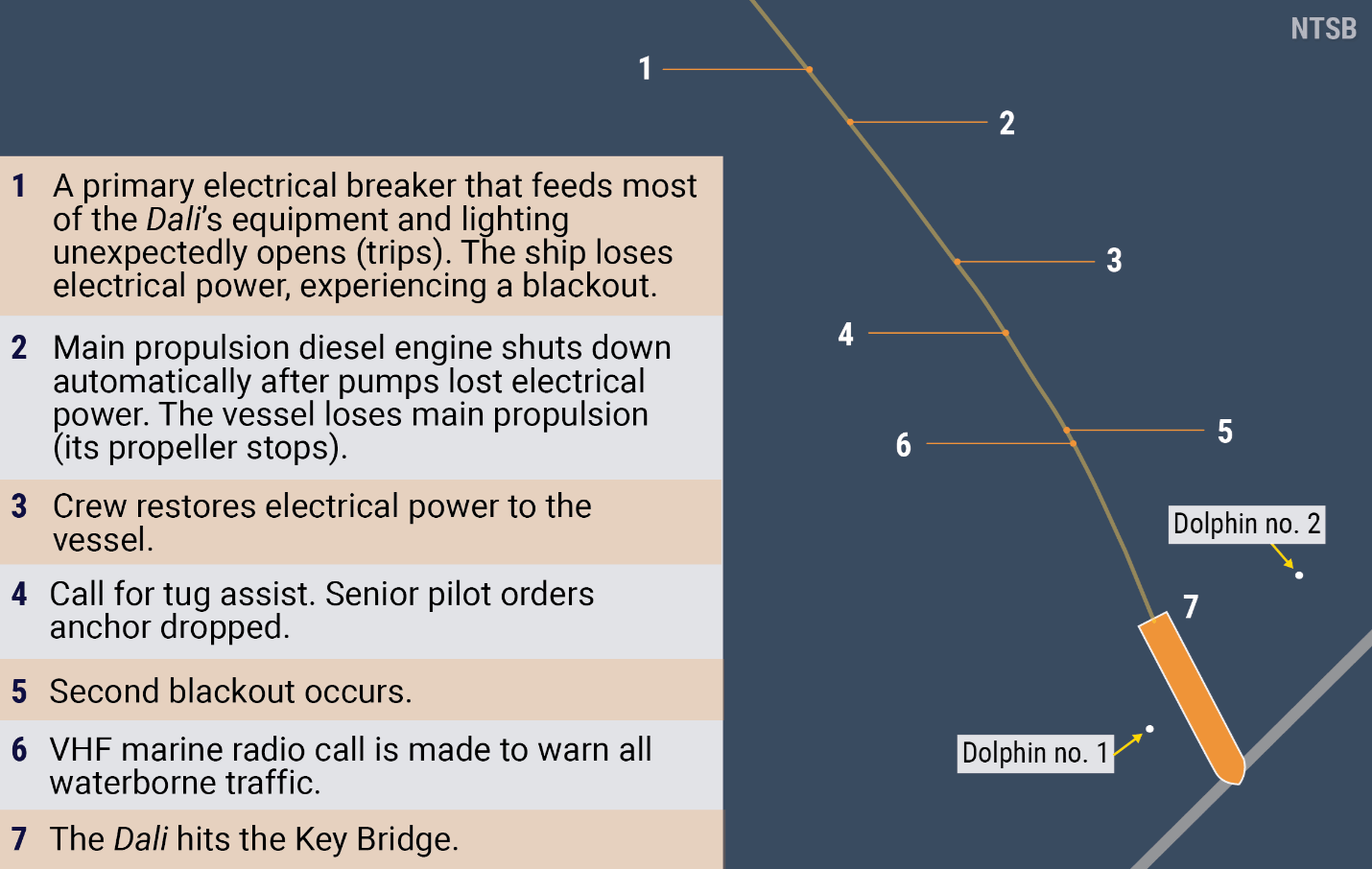

On 26 March 2024, MV Dali suffered a blackout while departing Baltimore.
Key facts:
- blackout occurred in confined waters
- propulsion and steering lost
- emergency systems activated
- recovery time exceeded stopping distance
- collision was unavoidable
This incident proves a critical PMS truth:
Black start capability is meaningless if recovery time exceeds available manoeuvring space.
Black start — misunderstood and over-trusted
Black start capability means:
- starting generators from dead ship
- restoring control power
- re-energising essential buses
It does not guarantee:
- propulsion before impact
- steering before grounding
- avoidance in confined channels
ETO trap:
“We have black start, so we’re safe.”
Black start is last-resort survival, not collision avoidance.
Why black start often fails in reality
- DC control power degraded
- batteries undersized or aged
- start sequences too slow
- human intervention required
- procedures not practised
Black start that works once a year on paper may fail when it matters.
Professional ETO mindset
Instead of asking:
- “Can we black start?”
Ask:
- How long until propulsion is restored?
- How far will the ship travel in that time?
- What is the worst-case location for a blackout?
Electrical recovery must be measured in distance, not seconds.
Knowledge to Carry Forward
A PMS is not a protection system — it is a time management system.
Load shedding buys seconds.
Black start buys minutes.
Neither guarantees survival if recovery exceeds available space.
The only safe blackout is the one that never fully happens.
Tags
ETO, Power Management System, Load Shedding, Blackout Recovery, Black Start, MV Dali, Marine Electrical Failure, SOLAS II-1, Ship Safety Systems