Fluid Movement, Invisible Losses, and Why Most Failures Are Self-Induced
ENGINE ROOM → Auxiliary & Support Systems
System Group: Fluid Transfer & Distribution
Primary Role: Movement of liquids under controlled pressure and flow
Interfaces: Cooling · Fuel · Lubrication · Bilge · Ballast · Firefighting · HVAC
Operational Criticality: Continuous
Failure Consequence: Loss of flow → overheating → contamination → cascading system failure
Pumps do not move fluid.
They create pressure differentials, and everything else follows.
Position in the Plant
Pumps and piping form the circulatory system of the ship. Every critical function — cooling, lubrication, fuel supply, fire safety, stability — depends on reliable fluid movement.
Yet pump failures are rarely intrinsic.
They are almost always system failures, caused by suction conditions, piping design, or operational misuse.
From an engineering perspective, pumps are victims more often than culprits.
[DIAGRAM – pump and piping system with suction and discharge conditions]
Contents
System Purpose and Design Intent
Pump Types and Application Reality
Suction Conditions and NPSH Reality
Piping Geometry, Losses, and Air Ingress
Control, Valves, and Flow Misconceptions
Wear, Cavitation, and Seal Degradation
Failure Development and Damage Progression
Human Oversight and Engineering Judgement
1. System Purpose and Design Intent
The purpose of pumps is to provide reliable flow under defined conditions.
Design assumes:
- clean suction
- adequate static head
- stable operating range
These assumptions are routinely violated in service.
Operating a pump outside its design envelope does not cause immediate failure. It causes progressive damage that appears unrelated until failure occurs.
| Fluid Characteristic | Best Pump Class | Why |
|---|---|---|
| High viscosity (fuel oil, lube oil) | Positive displacement | Maintains flow despite resistance |
| Low viscosity (seawater, freshwater) | Dynamic | Efficient high-volume transfer |
| Poor suction conditions | Positive displacement or submersible | Self-priming or no suction dependency |
| High pressure, low flow | Positive displacement | Pressure capability independent of flow |
| High flow, low pressure | Dynamic (axial/mixed) | Hydraulic efficiency |
| Intermittent / metered flow | Positive displacement | Predictable displacement |
2. Pump Types and Application Reality
A ship is not a single fluid system. It is a network of interacting liquid circuits moving fluids of radically different character for cooling, heating, lubrication, fuel transfer, and safety. Each of these fluids behaves differently under pressure, temperature, and motion, and the pump selected to move it defines whether the system operates smoothly or degrades continuously.
Pump selection is therefore not a matter of availability or convenience. It is a matter of fluid physics matched to system intent.
The characteristics of the fluid itself dominate this decision. Viscosity determines whether the fluid will shear, slip, or resist motion within clearances. Density and surface tension influence priming behaviour and cavitation susceptibility. Compressibility governs how the system reacts to pressure transients and valve movement. These properties are not abstract; they determine whether a pump builds pressure efficiently or destroys itself attempting to do so.
System characteristics are equally decisive. Required flow rate, discharge head, operating temperature, and pressure range define the energy the pump must impart to the fluid. A pump perfectly maintained but poorly matched to these requirements will fail predictably, regardless of maintenance quality.
Broadly, marine pumps fall into two fundamental classes: positive displacement pumps and dynamic (rotodynamic) pumps. The distinction is not academic. It defines how the pump interacts with the system under both normal and abnormal conditions.
Positive displacement pumps move a fixed volume of fluid per cycle. This volume is mechanically trapped within chambers that are alternately filled and emptied as the pump rotates or reciprocates. As a result, flow is largely independent of discharge pressure until mechanical or relief limits are reached.
This behaviour makes positive displacement pumps inherently self-priming. They do not rely on centrifugal force or continuous liquid columns to establish flow. For this reason, they are frequently used as priming pumps for other systems and as primary pumps where suction conditions are poor or fluid viscosity is high.
On board ship, positive displacement pumps are used where flow rates are small to moderate, but pressure requirements are high and predictable. Fuel oil systems, lubrication oil circulation, hydraulic systems, and metering applications rely on this class of pump because it can generate pressure reliably even with viscous fluids.
However, this same characteristic makes positive displacement pumps unforgiving. Because they will continue to displace volume regardless of downstream restriction, they must be provided with relief paths. A closed discharge valve does not reduce flow; it increases pressure until something yields. Relief valves are not optional accessories — they are structural necessities.
Positive displacement pumps appear in several common marine forms, each chosen for specific reasons. Reciprocating and piston pumps are capable of very high pressures but introduce pulsation and mechanical complexity. Screw and gear pumps provide smoother flow and are widely used in fuel and lubrication systems. Vane pumps offer compactness and moderate pressure capability, while ram-type arrangements appear in specialised applications where linear force is required.
| Pump Type | Key Advantages | Inherent Limitations | Typical Failure Drivers | Example Shipboard Use Case |
|---|---|---|---|---|
| Screw Pump | Smooth, non-pulsating flow; excellent for high-viscosity fluids; self-priming | Sensitive to abrasive contamination; internal clearances critical | Wear from dirty fuel, loss of efficiency, internal slip | Main engine fuel oil circulation and booster pumps |
| Gear Pump | Compact; robust; consistent displacement; good pressure capability | Pulsating flow; intolerant of debris; pressure spikes if blocked | Tooth wear, casing scoring, relief valve failure | Lube oil transfer, small fuel systems, purifier feed |
| Vane Pump | Quiet operation; good volumetric efficiency; compact | Vanes sensitive to wear and fluid cleanliness | Loss of vane sealing, reduced output | Hydraulic power units, steering auxiliary circuits |
| Reciprocating / Piston Pump | Very high pressure capability; accurate metering | Pulsation; mechanical complexity; high maintenance | Valve wear, seal failure, fatigue cracking | Chemical dosing, boiler feed in legacy systems |
| Ram-Type Pump | Simple force transmission; predictable pressure | Low flow rates; bulky | Seal leakage, corrosion | Steering or specialised hydraulic actuation |
| Positive Displacement (General) | Flow independent of discharge pressure; excellent priming | Requires relief valve; intolerant of dead-heading | Overpressure damage if relief fails | Fuel, lube oil, hydraulics, priming pumps |
Dynamic or rotodynamic pumps operate on a fundamentally different principle. Rather than trapping fluid, they impart velocity to it, converting kinetic energy into pressure as the flow is decelerated within the pump casing. Flow is continuous, pressure rise is a function of speed and system resistance, and discharge is inherently smoother.
| Pump Type | Key Advantages | Inherent Limitations | Typical Failure Drivers | Example Shipboard Use Case |
|---|---|---|---|---|
| Centrifugal Pump | Simple; low maintenance; smooth continuous flow; tolerant of debris | Not self-priming; sensitive to suction conditions | Cavitation, air ingress, seal failure | Seawater cooling, freshwater circulation, fire pumps |
| Axial Flow Pump | Very high flow rates; efficient at low head | Poor pressure capability; large physical size | Blade erosion, vibration | Ballast transfer, large circulation duties |
| Mixed Flow Pump | Balance between flow and pressure; compact | Narrow efficient operating range | Off-design operation wear | Ballast and cooling crossover applications |
| Submersible Pump | No suction limitation; compact installation | Seal and motor cooling dependency | Seal failure, insulation breakdown | Bilge wells, sewage tanks, emergency drainage |
| Dynamic (General) | Flow adjusts naturally to system resistance | Flow collapses with air or vapour | Cavitation, loss of prime | Cooling, ballast, bilge, firefighting |
Centrifugal pumps dominate marine systems for this reason. They are mechanically simple, tolerant of moderate debris, and well suited to low-viscosity fluids such as seawater, freshwater, and condensate. Their behaviour aligns naturally with cooling, ballast, bilge, and fire systems where large volumes must be moved at relatively low to moderate pressure.
However, centrifugal pumps are not self-priming. They require a continuous liquid column at the suction. Any interruption — air ingress, vapour formation, or excessive suction loss — collapses performance immediately. This is why centrifugal pumps are often paired with positive displacement priming arrangements in systems where suction conditions cannot be guaranteed.
Dynamic pumps also include axial-flow and mixed-flow designs, which trade pressure capability for very high flow rates. These are used in ballast, circulation, and specialised applications where volume, not head, is the dominant requirement. Submersible variants remove suction limitations entirely but introduce sealing, cooling, and accessibility challenges.
The critical point is that no pump is inherently good or bad. A centrifugal pump used in a high-viscosity fuel system will cavitate and overheat despite perfect maintenance. A positive displacement pump used in a high-flow cooling circuit will be inefficient, noisy, and mechanically overstressed.
Applying the wrong pump type does not cause immediate failure. It causes progressive damage that appears unrelated: seal leakage, bearing wear, vibration, or unstable flow. By the time the pump is blamed, the system mismatch has already done its work.
Pumps fail loudly.
Pump selection errors fail quietly.
3. Suction Conditions and NPSH Reality
Net Positive Suction Head is not theoretical.
Insufficient NPSH causes cavitation at the pump eye, even when discharge pressure appears normal.
Common contributors include:
- fouled strainers
- long suction runs
- air ingress at flanges
- high fluid temperature
Cavitation damage begins internally and is often invisible until performance collapses.
4. Piping Geometry, Losses, and Air Ingress
Piping design determines pump survivability.
Sharp bends, undersized lines, and poor routing introduce losses that reduce available suction head.
Air ingress is particularly destructive. Small leaks on suction lines do not leak liquid outward — they ingest air inward.
Air destabilises flow, accelerates cavitation, and causes seal and bearing distress.
5. Control, Valves, and Flow Misconceptions
Valves do not control flow.
They restrict it.
Throttling on suction is destructive. Throttling on discharge is acceptable within limits.
Misuse of valves to “control” pumps masks underlying system mismatch.
Flow control must respect pump curves, not operator convenience.
6. Wear, Cavitation, and Seal Degradation
Pump wear is cumulative.
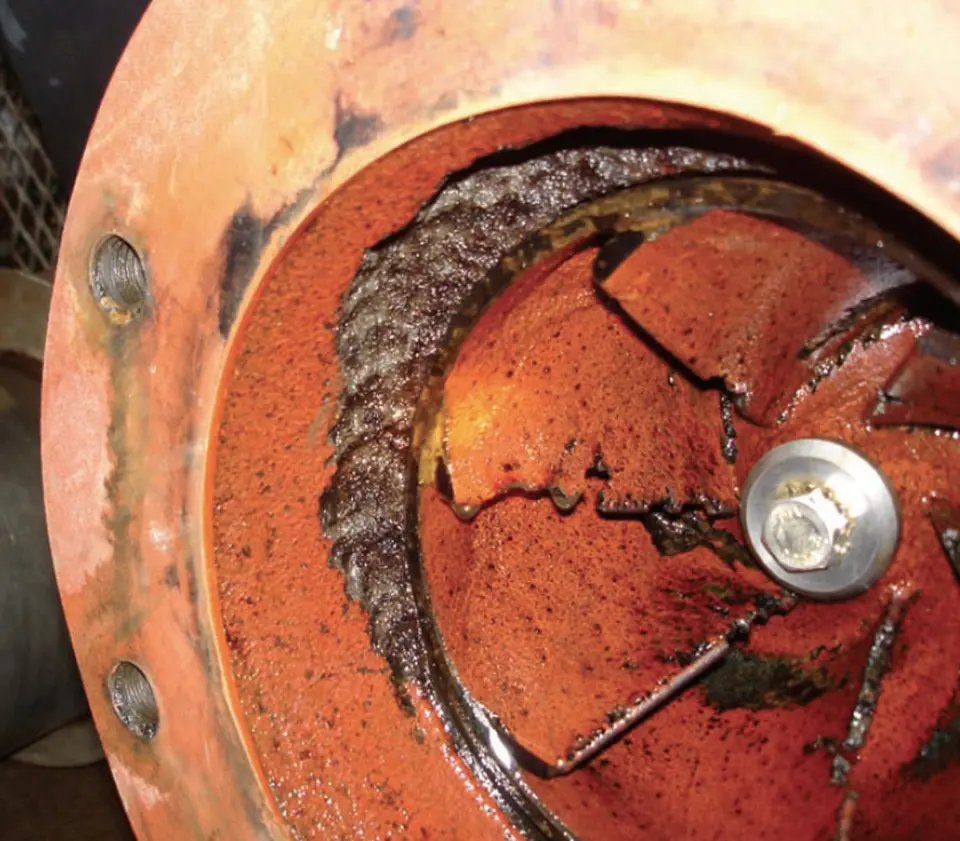
Cavitation roughens impeller surfaces, increasing turbulence and accelerating further cavitation.
Seal failure is often secondary. Excess vibration, misalignment, or pressure instability destroys seals that would otherwise survive.
Replacing seals without correcting root cause guarantees repeat failure.
7. Failure Development and Damage Progression
Pump failures progress through:
- suction degradation
- cavitation initiation
- vibration and noise
- seal leakage
- bearing failure
The pump is blamed. The system caused the failure.
8. Human Oversight and Engineering Judgement
Engineers protect pumps by:
- respecting suction conditions
- monitoring noise and vibration character
- understanding system curves
A pump that “still delivers flow” may already be operating destructively.
Judgement prevents recurrence. Replacement alone does not.
Relationship to Adjacent Systems and Cascading Effects
Pump and piping failures propagate into:
- cooling loss
- lubrication breakdown
- fuel starvation
- fire system impairment
Fluid movement is foundational. When it degrades, everything else follows.