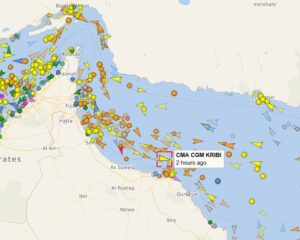
# Contextual Summary
The CMA CGM Kribi, a French-owned containership with a capacity of 5,466 TEU, has successfully transited the Strait of Hormuz, becoming the first confirmed Western Europe-linked vessel to navigate the chokepoint since regional tensions escalated. The 2014-built vessel’s passage marks a notable development in maintaining critical shipping corridors through one of the world’s most strategically important waterways, through which roughly one-third of global maritime trade passes daily.
The transit underscores the continued operational challenges facing container lines serving European markets amid ongoing regional security concerns. While major carriers have implemented enhanced protocols and risk assessments for Hormuz transits, the CMA CGM Kribi’s successful passage demonstrates that European-linked services remain viable, albeit with increased operational costs and insurance premiums. The French shipping giant has maintained selective European-Asia services despite regional volatility, balancing commercial imperatives against security considerations.
The successful transit carries significance for the broader container shipping sector, where route planning and risk management have become critical competitive factors. Shippers and operators will be monitoring whether this passage encourages a broader resumption of European-routed traffic through the strait, or whether it remains an exception. Any prolonged disruption of Hormuz transits typically triggers increased volumes through alternative routes such as the Cape of Good Hope, adding significant time and expense to voyages and affecting global supply chain reliability.