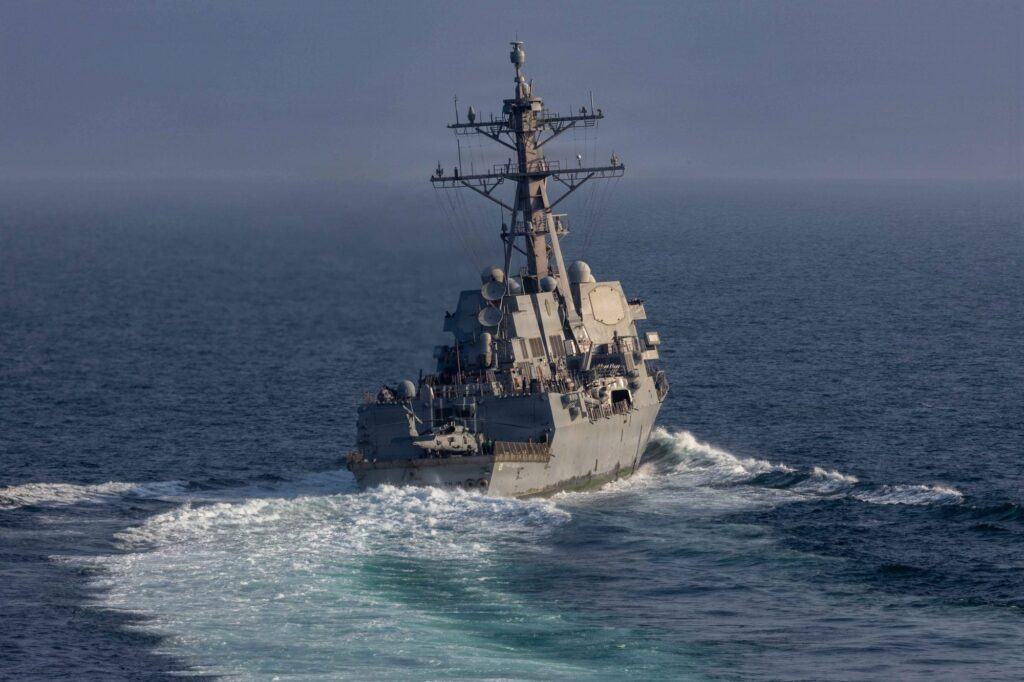
Arleigh Burke-class guided-missile destroyer USS Frank E. Petersen Jr. (DDG 121) sails in the Arabian Sea during Operation Epic Fury, March 18, 2026. (U.S. Navy photo)
US-Sanctioned Tanker Tests Trump Blockade With Hormuz Exit
Apr 14, 2026 (Bloomberg) –A US-sanctioned tanker linked to China is sailing out of the Strait of Hormuz and into the Gulf of Oman, testing President Donald Trump’s naval blockade.
, a medium-range tanker earlier known as
by Washington in 2023 for helping Tehran evade energy sanctions. It is not clear on this occasion whether it visited Iranian ports before its transit, or is carrying cargo.
The exit is a second attempt for the carrier, which began a first as the US blockade
on Monday, only to turn back. It then restarted hours later, and appeared to turn the bend into the eastern side of Hormuz on Tuesday.
Shipowners, energy traders and investors across financial markets have been keenly following its route through Hormuz as they try to understand the latest US effort to pressure Tehran and curb its oil revenues — and how it will work in practice.
“The real issue is not simply whether ships can pass through Hormuz, but what spectrum of enforcement options US warships apply, and where they choose to apply them,” said Charlie Brown, an advisor to United Against Nuclear Iran, a US lobby and pressure group focused on Tehran.
initially transmitted that it had a Chinese owner and crew — a common safety mechanism for ships crossing the strait during the current conflict in the Persian Gulf, and one that could test Washington’s resolve to challenge vessels tied to the world’s largest oil importer. The tanker has now switched to indicating the Omani port of Sohar as its destination, according to ship-tracking data show.
Throughout the crossing, the tanker’s location signals have not been consistent. Vessels in the area have regularly been impacted by electronic interference which can produce inaccurate speed and location reports.
, was in the strait and headed into the Gulf of Oman just as the blockade began. It appears to have stopped out of the narrow waterway and off the Iranian coast. Ship-tracking platforms Kpler and Vortexa indicate that
had docked at an Iranian port in the gulf before attempting to pass through Hormuz, meaning it would be a potential target for a patrolling US navy vessel.
by the US last year under its former name,
, over its links to the Iranian oil trade.
What to Know About the US Blockade of Iran’s Ports
Most shipowners reached by Bloomberg across the Middle East and Asia — who now face the need to clear both Iranian and US approvals to exit the Persian Gulf — said they would pause any effort to make their way through the strait until the workings of the blockade are clear.
Trump’s blockade has also sparked alarm among Asian nations that rely heavily on Middle Eastern energy and fuel exports. China’s Foreign Minister Wang Yi has
global stakeholders to push for peace talks between Tehran and Washington, according to a readout released by Beijing on Monday.
Any effort to interdict a Chinese vessel would unsettle markets and sentiment further.
“At best, Trump’s announcement is a paper tiger. At worst, it marks an escalation,” said Carlos Casanova, senior Asia economist at Union Bancaire Privee in Hong Kong.
has indicated it is sailing under a Malawi flag, but the landlocked African nation has
it has no official registry for oceangoing ships.
is owned by Full Star Shipping Ltd., which shares the same contact details as Shanghai Xuanrun Shpg. Co. Ltd., maritime database Equasis shows. A call made to Shanghai Xuanrun did not get through, while the company didn’t respond to an emailed request for comment. The Shanghai-based entity is also sanctioned by the State Department.
’s owner is Chartchemical SA that uses its manager, IMS Ltd.’s contact details. A call made to Malaysia-based IMS failed to connect. IMS did not respond to an emailed request for comment.
© 2026 Bloomberg L.P.