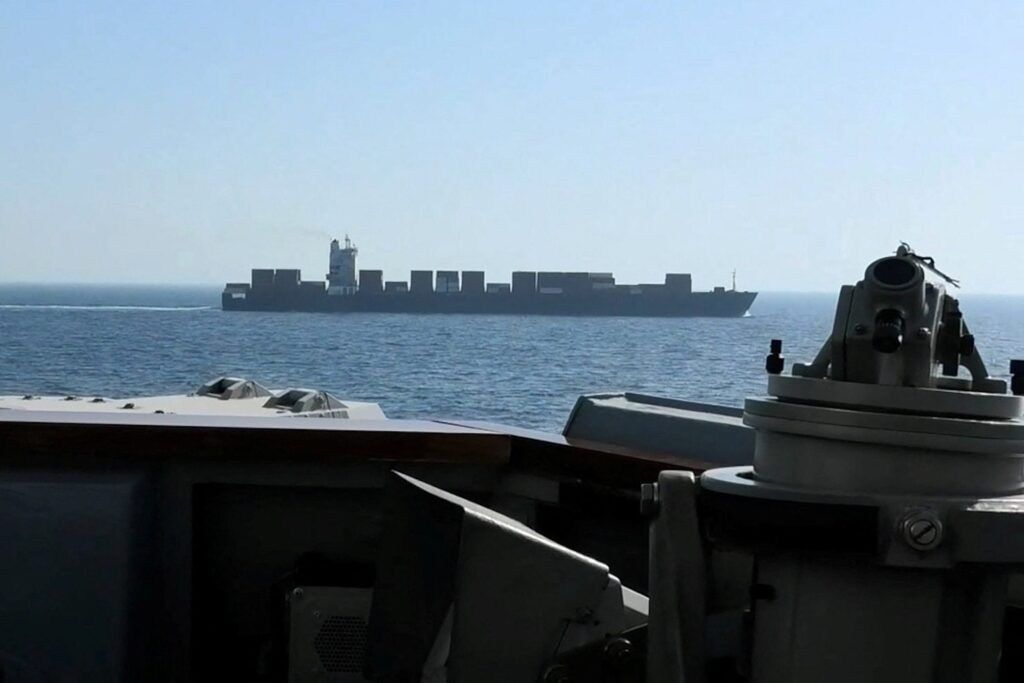
A view of Iranian-flagged cargo ship M/V Touska as the U.S. Navy Arleigh Burke-class Aegis guided missile destroyer USS Spruance conducts its interception in a location given as the north Arabian Sea, in this screen capture from a video released April 19, 2026. CENTCOM/Handout via REUTERS
Hormuz Crisis Enters Dangerous New Phase as U.S. Seizes Vessel and Attacks Resume
A volatile weekend in the Strait of Hormuz has exposed the widening gap between political claims that the waterway is “open” and the operational reality facing commercial shipping, as attacks, enforcement actions, and inconsistent transit approvals pushed the crisis into a more dangerous phase.
Within a span of 48 hours, multiple vessels were fired upon near Oman, a U.S. Navy destroyer disabled and seized an Iranian-flagged cargo ship, and maritime tracking data revealed a fragmented pattern of movement through the strait—some vessels transiting, others turning back, and many remaining stalled.
The developments suggest the Strait is not reopening, but evolving into a contested and selectively accessible corridor shaped by overlapping Iranian control and U.S. enforcement.
Attacks Resume After Ceasefire Lull
The weekend escalation began Saturday with the first confirmed attacks on commercial shipping since the April 7 ceasefire.
According to United Kingdom Maritime Trade Operations (UKMTO), a containership was struck by an unknown projectile northeast of Oman, while a tanker reported being fired upon by vessels linked to Iran’s Islamic Revolutionary Guard Corps (IRGC) Navy. A third incident involved a projectile splash near a cruise ship transiting close to Omani waters.
The attacks broke a 10-day lull and reinforced warnings from industry groups that threat levels in the region remained elevated despite diplomatic messaging.
U.S. Enforces Blockade With Vessel Seizure
The situation escalated further Sunday when U.S. Central Command confirmed that American forces disabled and boarded the Iranian-flagged cargo vessel
after it failed to comply with repeated warnings while attempting to reach an Iranian port.
The interception, carried out by the guided-missile destroyer USS
, marks the most aggressive enforcement action yet under Washington’s expanding maritime blockade, which now includes global authority to stop, board, and seize vessels linked to Iranian trade.
U.S. officials said dozens of vessels, some 27 in fact, have already complied with orders to turn around since the blockade began April 13.
The incident signals a shift from deterrence to direct action—and raises the risk of reciprocal measures.
“Iran recently announced that they were closing the Strait, which is strange, because our blockade has already closed it,” President Donald Trump said on social media.
Iran Tightens Control Under ‘Maritime Regime’
At the same time, Iran is moving to formalize its own system of control over the strait.
Officials have said vessels must coordinate with IRGC forces and transit along designated routes, in what has been described as a new “maritime regime” governing access. Under that framework, commercial shipping is effectively denied unless specifically authorized, with approvals appearing inconsistent and subject to rapid change.
Over the weekend, several vessels were challenged or forced to alter course despite indications they had clearance to transit—highlighting the fragility of any permission-based system.
Selective Transits Highlight Fragmentation
Despite the tightening controls, limited movements through the strait did occur.
According to MarineTraffic, six cruise ships stranded in Gulf ports since late February were able to transit between April 17 and April 19 during a narrow window following Iran’s initial reopening announcement.
In contrast, other vessels faced disruption.
Two sanctioned tankers—
—were forced to turn back while attempting outbound passages, while the Chinese cargo vessel
was reported anchored near Larak Island amid uncertainty over routing and authorization.
Separately, tracking data indicates that while a cargo-laden vessel such as
was intercepted, an Iranian-flagged tanker in ballast was able to enter the Gulf—suggesting that cargo type, compliance posture, and timing are now determining outcomes.
Dual-Control System Emerges
The weekend’s events point to a system increasingly defined by two overlapping—and conflicting—forces: Iran controlling routing and access through authorization and designated lanes, while the United States enforces a blockade targeting Iranian-linked cargoes and vessels.
For shipowners, that creates a layered risk environment where compliance with one system may expose vessels to enforcement from the other.
At the same time, renewed attacks add a third dimension where ships and crews face a physical threat.
Ceasefire Under Pressure
The escalation comes just days before the current U.S.–Iran ceasefire is set to expire on April 22.
Both sides have taken hardened positions. Iran has said it will not negotiate further unless the U.S. lifts its blockade, while Washington has signaled enforcement will continue.
U.S. President Donald Trump accused Iran of violating the ceasefire over the weekend, citing reported gunfire incidents in the strait and warning of further consequences if a deal is not reached.
“If they don’t take the deal… the United States is going to knock out every single power plant, and every single bridge, in Iran,” President Donald Trump warned.
Taken together, the events of the past 48 hours reinforce a broader conclusion that the Strait of Hormuz is no longer functioning as a predictable commercial corridor.
Even vessels attempting neutral transit now face uncertainty over routing, compliance, and security.
The notion that the Strait of Hormuz has reopened is increasingly difficult to sustain. What has emerged instead is a fragmented and unstable system that is anything by normal. With insurers, charterers, and shipowners still assessing the risk environment, a rapid return to normal traffic levels appears unlikely.
With the ceasefire deadline approaching and both sides escalating their positions, the next phase of the crisis may prove even more consequential for global shipping and energy markets.