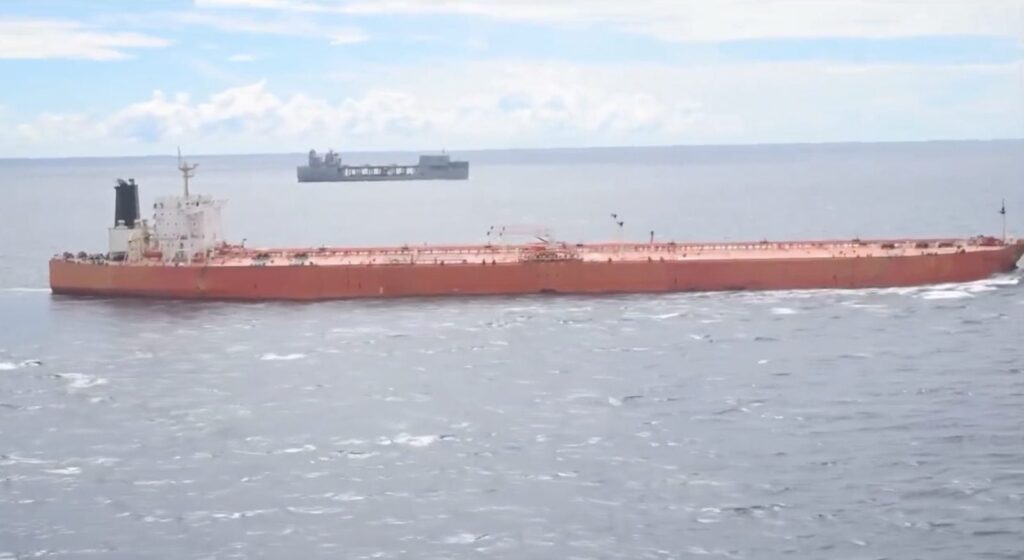
U.S. forces board the stateless tanker Tifani (IMO: 9273337) without incident inside the U.S. Indo-Pacific Command area of responsibility. Photo from Department of War video
U.S. Forces Board Sanctioned Tanker in Indo-Pacific as Iran Crackdown Expands Beyond Hormuz
U.S. forces have boarded a sanctioned oil tanker in the Indo-Pacific, signaling a widening of Washington’s maritime enforcement campaign against Iran-linked shipping far beyond the Strait of Hormuz flashpoint.
In a statement posted overnight, the Department of War said U.S. forces conducted a “right-of-visit, maritime interdiction and boarding” of the stateless tanker
(IMO: 9273337) without incident inside the U.S. Indo-Pacific Command area of responsibility.
Officials said the vessel was falsely flying the flag of Botswana and had previously been sanctioned for transporting Iranian petroleum. The boarding marks a notable expansion of U.S. operations, which had until now been concentrated around the Persian Gulf and Strait of Hormuz.
“International waters are not a refuge for sanctioned vessels,” the Department said, adding that the U.S. would pursue illicit networks “anywhere they operate.”
Overnight, U.S. forces conducted a right-of-visit, maritime interdiction and boarding of the stateless sanctioned M/T Tifani without incident in the INDOPACOM area of responsibility.??As we have made clear, we will pursue global maritime enforcement efforts to disrupt illicit…
pic.twitter.com/EGwDe3dBI3
— Department of War ?? (@DeptofWar)
was sanctioned by U.S. authorities on July 30, 2025 for its role in transporting Iranian petroleum and has been identified as falsely flying the flag of Botswana.
That earlier action was part of a broader sanctions package under Executive Order 13846, which targeted 20 entities involved in Iranian petroleum, petroleum products, and petrochemical trade, while also identifying 10 vessels as blocked property.
As outlined at the time, the measures also included action against ENSA Ship Management Private Limited, the vessel’s commercial manager since December 2024. U.S. officials said
conducted at least two ship-to-ship transfers involving Iranian oil during ENSA’s tenure, both carried out with U.S.-designated Iranian-flagged tankers while operating with its AIS turned off in the Singapore Eastern Outer Port Limits.
Enforcement Goes Global
The boarding underscores the U.S. shift from regional disruption to global interdiction.
Over the weekend, U.S. forces disabled and boarded an Iranian-linked cargo vessel in the Strait of Hormuz after it failed to comply with orders, part of a broader blockade effort that has already forced dozens of vessels to turn back.
For shipowners and operators, that combination is creating a compliance maze with no clear safe harbor. A vessel avoiding Iranian-controlled routes could still face U.S. interdiction elsewhere, while those complying with U.S. directives risk denial of passage in the Gulf.
A System Under Strain
The latest boarding comes as the broader Hormuz crisis enters an increasingly unstable phase.
The addition of global interdiction operations raises the stakes further, extending risk calculations well beyond the Gulf and into key maritime corridors across Asia.
With a fragile ceasefire nearing expiration and both sides escalating enforcement, the maritime domain is rapidly shifting from a contested chokepoint to a globally contested network.