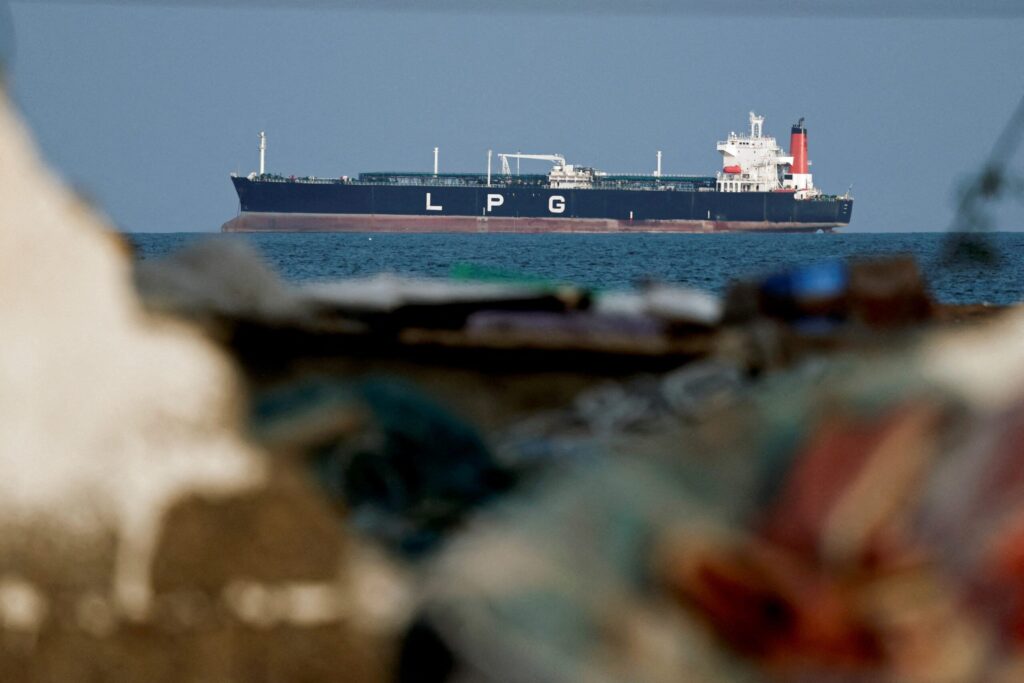
An LPG gas tanker at anchor as traffic is down in the Strait of Hormuz, amid the U.S.-Israeli conflict with Iran, in Shinas, Oman, March 11, 2026. REUTERS/Benoit Tessier
All Eyes on Hormuz as U.S. Maritime Blockade on Iran Enters Enforcement Phase
The United States’ newly announced maritime blockade targeting Iranian trade is now entering its enforcement phase, with fresh guidance from United Kingdom Maritime Trade Operations confirming that access restrictions are actively being applied across Iranian waters.
In an advisory issued Monday, UKMTO said it had been informed that, effective 1400 UTC on April 13, maritime access restrictions are now in force affecting “Iranian ports and coastal areas,” including waters spanning the Arabian Gulf, Gulf of Oman, and the Arabian Sea east of the Strait of Hormuz.
The guidance underscores the breadth of the measure, stating that restrictions apply “without distinction to vessels of any flag” engaged with Iranian ports, oil terminals, or coastal infrastructure—reinforcing earlier messaging from U.S. Central Command that the blockade would be enforced impartially across global shipping.
Crucially, the advisory stops short of declaring a closure of Hormuz itself. UKMTO said transit passage to or from non-Iranian destinations “is not reported to be impeded,” but warned that vessels may encounter military presence, directed communications, and potential right-of-visit procedures during passage.
The distinction reflects a rapidly evolving operating environment in which the waterway remains technically open, but increasingly shaped by overlapping layers of control, enforcement, and risk.
UKMTO added that the restrictions encompass the entirety of Iran’s coastline, including ports and energy infrastructure, effectively drawing a maritime boundary around Iranian trade rather than the strait itself.
At the same time, vessels currently in Iranian ports have reportedly been granted a limited grace period to depart, with further details expected through formal Notices to Mariners. Additional guidance on routing, authorization procedures, and inspection requirements remains under development.
For shipowners and operators, the lack of clarity is likely to prolong hesitation in returning to the region.
The advisory comes as the security environment across Hormuz remains highly unstable. Previous assessments have already highlighted altered routing patterns near Larak Island, persistent concerns over sea mines in traditional Hormuz routes, and the emergence of coordinated or conditional transit practices tied to military oversight.
UKMTO emphasized that all existing threat assessments remain in place, referencing ongoing risks outlined in recent maritime security advisories.
The U.S. approach mirrors earlier enforcement actions in the Caribbean, where Washington has already demonstrated a willingness to interdict sanctioned oil flows tied to Venezuela. Since late 2025, U.S. forces have boarded and seized at least seven tankers linked to Venezuelan crude exports as part of a broader maritime blockade campaign targeting the country’s “shadow fleet.”
Those operations—carried out by units under U.S. Southern Command and other agencies—have included high-seas boardings, long-range pursuits, and the capture of vessels accused of violating sanctions or operating without proper registration, signaling a precedent for aggressive enforcement that could now be applied in the Strait of Hormuz.
Mariners operating in the Hormuz region are now being urged to maintain heightened situational awareness, ensure maximum bridge readiness, and exercise caution in communications—standard language that, in the current context, signals an elevated likelihood of interaction with military forces.
Separately, U.S. President Donald Trump intensified rhetoric surrounding the operation, claiming Iran’s navy has been “completely obliterated,” with 158 vessels destroyed, while warning that any remaining fast attack craft approaching U.S. blockade enforcement zones would be “immediately eliminated.” The comments, delivered via social media, signal a zero-tolerance posture toward potential interference near the blockade perimeter.
“What we have not hit are their small number of, what they call, “fast attack ships,” because we did not consider them much of a threat,” Trump wrote on Truth social. “Warning: If any of these ships come anywhere close to our BLOCKADE, they will be immediately ELIMINATED, using the same system of kill that we use against the drug dealers on boats at Sea.”
The statement appears to contrast with long-standing assessments of Iran’s maritime doctrine, which relies heavily on small, fast attack craft and other asymmetric tactics to disrupt traffic in constrained waterways like Hormuz. While such vessels lack conventional naval power, they remain central to the threat environment facing commercial shipping.
Taken together, the latest advisory and U.S. messaging confirm a broader shift now underway in the world’s most critical energy corridor.