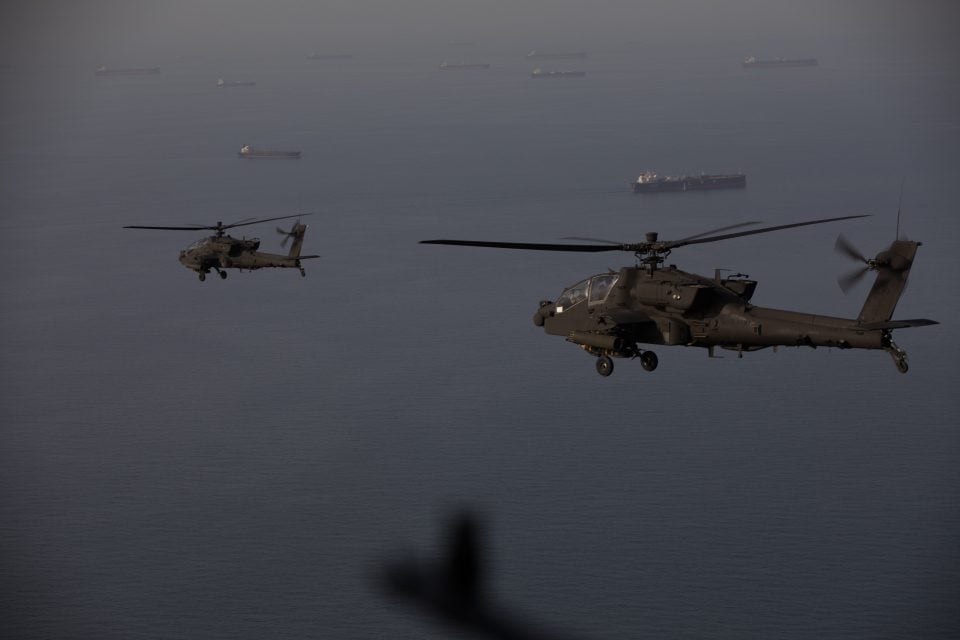
AH-64 Apache helicopters fly over the Strait of Hormuz, April 17, 2026, with multiple commercial vessels visible below, as U.S. Army crews maintain a persistent aerial presence to support freedom of navigation and monitor maritime traffic in the strategic waterway. U.S. Central Command Photo
Chubb Says U.S. Hormuz Insurance Backstop Stalled as Military Convoys Fail to Materialize
Washington’s headline-grabbing maritime insurance backstop for the Strait of Hormuz appears stuck on the launchpad.
Comments this week from Chubb Chairman and CEO Evan Greenberg suggest the Trump administration’s much-publicized
$40 billion maritime reinsurance facility
has not stalled for lack of underwriting capacity, but because the military escort concept at its core has yet to materialize.
Speaking during Chubb’s April 22 earnings call, Greenberg disclosed the federally backed program was designed not as a standalone commercial insurance product, but as part of a U.S.-run convoy system intended to support transits through the Gulf. Chubb was
tapped to serve as the lead insurance partner
“The government wanted to support shipping through the Gulf … with military convoys,” Greenberg said. “That has yet to occur.”
The remarks offer the clearest explanation yet for why a program
as a breakthrough to revive commercial traffic through the conflict-hit chokepoint has seen little visible uptake.
When the plan was unveiled, U.S. officials framed it as far more than a financial backstop, presenting it as a strategic mechanism to help reopen one of the world’s most vital energy corridors.
Announcing the initiative alongside the Treasury Department, U.S. International Development Finance Corporation Chief Executive Ben Black said the facility—developed in coordination with United States Central Command—would pair federal reinsurance with a security framework capable of restoring flows of oil, LNG, jet fuel and other critical commodities through the Strait of Hormuz.
“DFC coverage will offer a level of security no other policy can provide,” Black said at the time.
Greenberg’s latest comments suggest that security component—particularly the convoy element embedded in the original concept—was more central to the plan than previously understood.
Under the structure he described, participation in the insurance program is tied directly to participation in U.S.-run convoys, a significant detail that had not been explicit before.
“The purchase of our insurance program is a condition to being part of a convoy that the U.S. would run,” Greenberg said, adding U.S. insurers assume 50% of the risk while a federal entity takes the remainder.
That suggests the backstop was never simply meant to replace missing war-risk cover, but to function as one leg of a broader security architecture built around naval protection, government risk-sharing and escorted transits. Without the convoy piece, that model has effectively remained dormant.
That matters because the original premise behind Washington’s intervention assumed insurance capacity was the main bottleneck keeping ships out of the Gulf.
But that premise has shifted. Voyage-by-voyage war-risk cover, while costly, largely returned. Shipowner confidence did not.
Operators remain deterred by physical threats—mines, missile and drone attacks, electronic interference and uncertainty over safe passage—reinforcing what many in the industry have argued for weeks: insurance was never the core problem. Security was.
Greenberg’s comments appear to validate that assessment.
They also help explain why expanding the facility from $20 billion to $40 billion earlier this month did little to alter traffic patterns.
In effect, the backstop may have been waiting on a naval escort strategy that never fully arrived.
That stands in contrast to early expectations the program could help jumpstart traffic through the Strait after transits collapsed by more than 80% at the height of the crisis.
Greenberg framed the effort in geopolitical more than commercial terms.
“We have done it… to support our country and support our military,” he said, adding the facility remains in place should conditions change.
The comments may also temper speculation that the muted response reflected weak demand or flaws in the underwriting structure. By Greenberg’s telling, the program did not launch and disappoint—it never truly got off the ground.