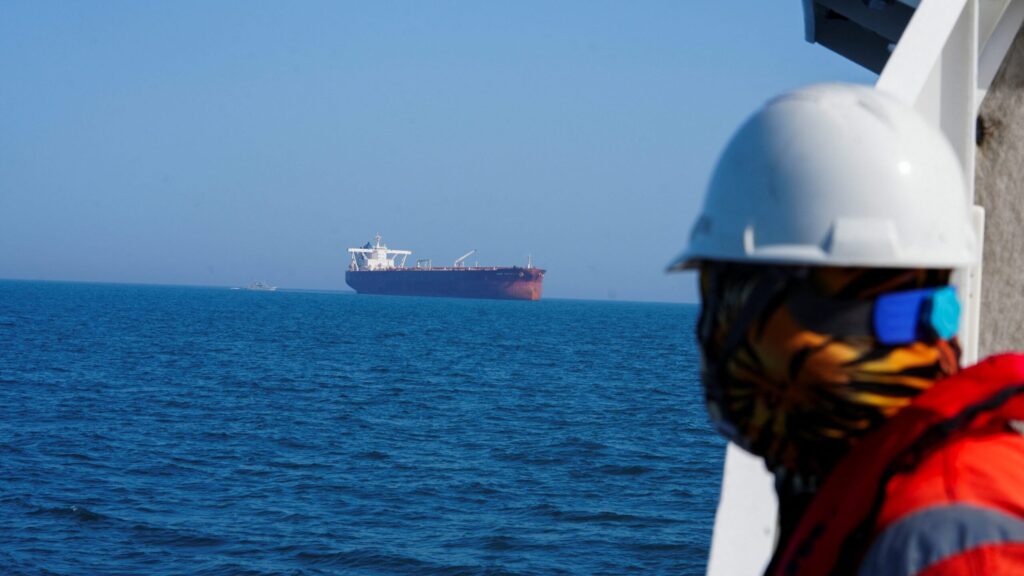
The Malta-flagged tanker Agios Fanourios I, an oil tanker that sailed through the Strait of Hormuz, arrives in Iraq’s territorial waters off Basra,Iraq April 17, 2026. REUTERS/Mohammed Aty
Iran’s Navy Tells Ships Strait of Hormuz Shut Again, Two Vessels Report Gunfire
ATHENS, April 18 (Reuters) – Merchant vessels attempting to cross the
on Saturday received radio messages from Iran’s navy telling them they were not allowed to pass, while two ships reported being hit by gunfire, shipping sources said.
Several commercial vessels tried to transit the strait after
to mariners a day earlier saying passage would be allowed but restricted to lanes Iran deemed safe.
Shipping Industry Pushes Back on ‘Open’ Hormuz Narrative as Risks Persist
On Saturday, at least two ships reported that Iranian boats fired shots, shipping and maritime security sources told Reuters. The incidents were reported in waters between the Qeshm and Larak islands. The vessels turned back without completing the crossing, the sources said.
The United Kingdom Maritime Trade Operations (UKMTO) agency said it had received a report of an incident 20 nautical miles northeast of Oman. The captain of a tanker said it had been approached by two Islamic Revolutionary Guard Corps gunboats that fired on the vessel. The tanker and its crew were safe.
A container ship was also hit by gunfire, a maritime security source said.
Some vessels reported that Iran’s navy had been broadcasting a VHF message saying the Strait of Hormuz was closed again.
“Attention all ships, regarding the failure of the U.S. government to fulfill its commitment in the negotiation, Iran declares the Strait of Hormuz completely closed again. No vessel of any type or nationality is allowed to pass through the Strait of Hormuz,” the radio message said.
Hundreds of ships and about 20,000 seafarers
remain stranded in the Gulf
, waiting to pass through the key waterway, which handles about 20% of global oil and liquefied natural gas flows.