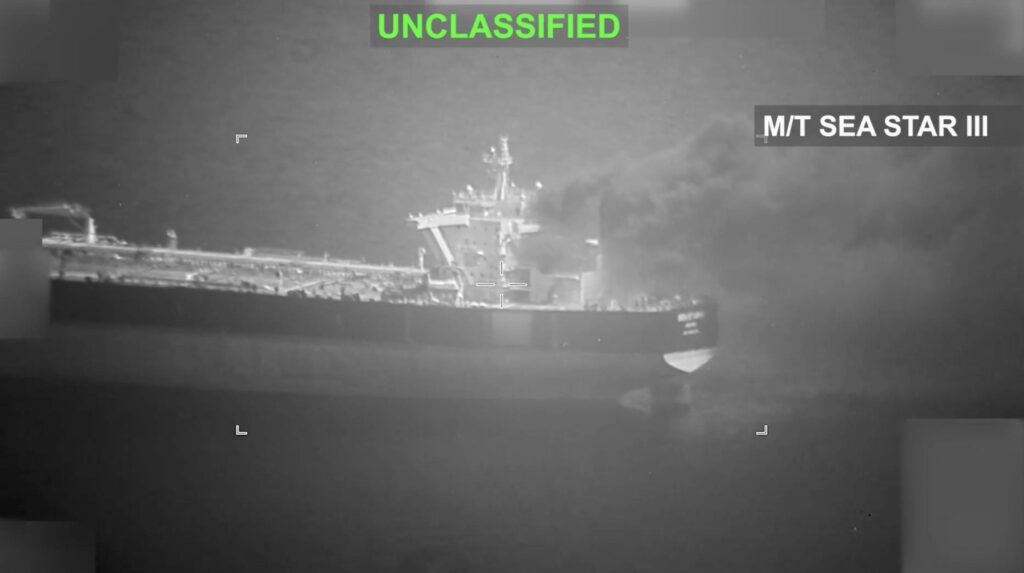
Fire and thick black smoke rise from the Iranian-linked tanker Sea Star III near Bandar-e Jask in the Gulf of Oman after the vessel was reportedly disabled by a U.S. Navy F/A-18 Super Hornet during blockade enforcement operations.
Photos Appear to Show Fire Aboard Iranian VLCC Disabled by U.S. Navy
New images circulating online appear to show damage and an active fire aboard the Iranian tanker
days after the vessel was
by a U.S. Navy fighter jet during blockade enforcement operations near the Gulf of Oman.
The photos, posted Monday, purportedly show scorch marks and flames near the funnel area of the National Iranian Tanker Company (NITC) VLCC
(IMO 9569205). Notably, the vessel is not carrying any cargo.
“The National Iranian Tanker Company (NITC) VLCC supertanker SEA STAR III (9569205) after her funnel was fired at by a US Navy F/A-18 Super Hornet from USS George H.W. Bush (CVN 77) on 2026-05-08 at 25.63345, 57.92449,” TankerTrackers wrote in a post on X. The coordinates place the vessel near the Iranian port area of Bandar-e Jask in the eastern Gulf of Oman, just outside the Strait of Hormuz.
The authenticity of the images has not been independently verified by gCaptain, but the visible damage and fire location are consistent with reports describing strikes targeting the vessel’s smokestack or funnel area. No firefighting craft or response vessels are visible in the frame.
TankerTrackers previously said satellite imagery appeared to show both
anchored east of Iran’s Bandar-e Jask peninsula following the strikes, adding that a fire was still burning aboard
Smoke rises from the Iranian-flagged tanker M/T Sea Star III in a surveillance image released by United States Central Command after the vessel was disabled by a U.S. Navy F/A-18 Super Hornet during blockade enforcement operations in the Gulf of Oman on May 8, 2026.
was one of two Iranian-flagged tankers
by U.S. forces on May 8 as part of Washington’s expanding naval blockade enforcement campaign against Iran.
According to United States Central Command, an F/A-18 Super Hornet launched from the
USS George H.W. Bush (CVN-77)
fired precision munitions into the smokestacks of both
before the ships could enter an Iranian port on the Gulf of Oman.
CENTCOM said the strikes were intended to disable the vessels rather than sink them.
“U.S. forces in the Middle East remain committed to full enforcement of the blockade of vessels entering or leaving Iran,” CENTCOM commander Adm. Brad Cooper said in a statement released May 8. “Our highly trained men and women in uniform are doing incredible work.”
The command said more than 50 commercial vessels had already been redirected and multiple ships disabled as part of the blockade enforcement effort.
The U.S. enforcement campaign has coincided with repeated clashes between Iranian and American forces in and around the Strait of Hormuz, including missile and drone attacks on commercial ships, sea mine threats, and retaliatory strikes targeting naval assets and Iranian-linked vessels.
Commercial traffic through the Strait of Hormuz remains severely disrupted despite repeated diplomatic efforts aimed at stabilizing the region.
The situation has also intensified humanitarian concerns for thousands of seafarers stranded aboard vessels across the Gulf region as shipping activity remains far below normal levels.