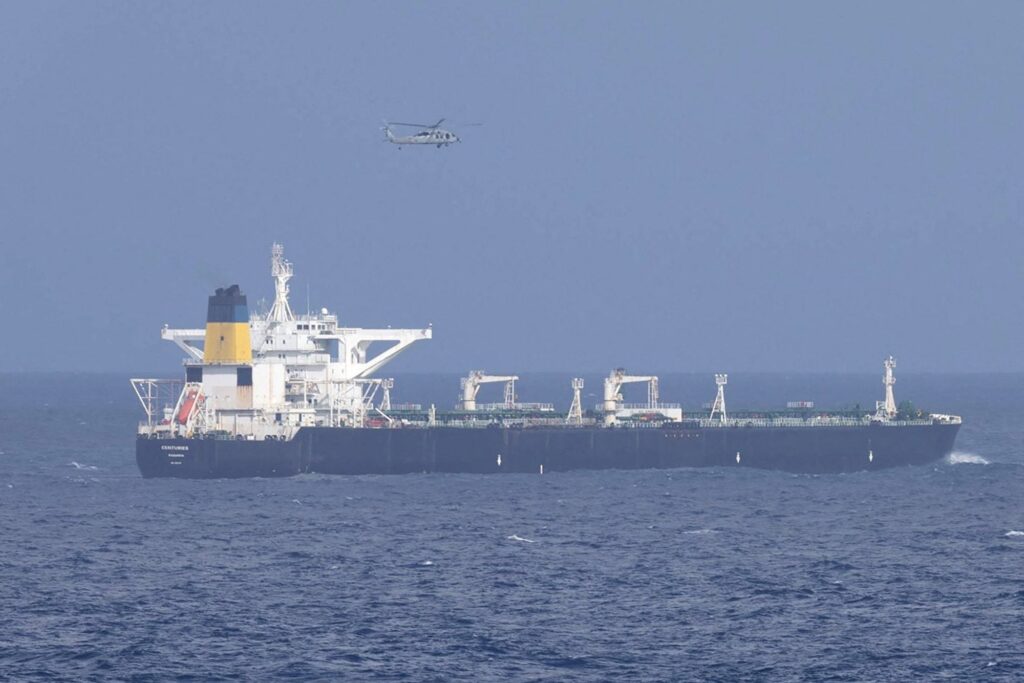
A U.S. military helicopter flies over the Panama-flagged Centuries, which was intercepted by the U.S. Coast Guard, days after U.S. President Donald Trump announced a “blockade” of all sanctioned oil tankers entering and leaving Venezuela, east of Barbados in the Caribbean Sea December 20, 2025. DHS/Handout via REUTERS
Repeating Venezuela-Blockade Move Is Far Riskier Bet in Hormuz
By Julian Lee (Bloomberg) — US President Donald Trump is invoking his Venezuela playbook with a pledge to blockade Iranian ships. But Iran poses more complicated logistics, higher risks for American soldiers and a more resilient enemy.
The US “will begin the process of BLOCKADING any and all Ships trying to enter, or leave, the Strait of Hormuz,” Trump said in a social media post on Sunday, after talks between American and Iranian delegations aimed at ending the six-week-old war broke down without agreement.
If successfully enforced — and how it will be enforced is far from clear — such a move would amount to a bet that economic pain inflicted on Tehran will be enough to force it to accept US demands before the Persian Gulf nation’s own effective closure of the waterway upends the global economy.
All Eyes on Hormuz as U.S. Maritime Blockade on Iran Enters Enforcement Phase
The plan is for the US military to wait outside the Persian Gulf for ships sailing from Iran to leave the region. That echoes a tactic employed in Venezuela that — alongside the capture of Nicolas Maduro — allowed Trump to wrest control of the Latin American nation’s oil.
This blockade is intended hit Iran’s exports, currently the only oil still leaving the region in any volume and an economic lifeline for Tehran. The question is how big the impact will be.
Iran’s oil exports are far higher than Venezuela’s during the
blockade of the Latin American country
, meaning that a higher level of military intervention will be needed. Tehran also continues to pose enough of a military threat to keep shipping through Hormuz all but halted to other nations’ trade, despite a fragile ceasefire being in place.
The US Central Command said it was to begin to implement its measure at 10 a.m. Eastern Time on Monday, or about 6.30 p.m. in Tehran. It also provided a more-detailed explanation of the approach than the one set out by Trump.
U.S. Blockade Draws New Red Lines in Strait of Hormuz Crisis
In a subsequent notice to mariners, Centcom warned that unauthorized ships in blockaded areas will be subject to “interception, diversion, and capture.” The blockade will be enforced in Gulf of Oman and the Arabian Sea — waters outside the Persian Gulf — and the restrictions won’t be limited to ports and oil terminals, it said.
Among the questions now are how aggressively the US will enforce its blockade, how much force Iran will prepared to use to protect its shipping interests, especially oil tankers, and what retaliatory steps Tehran might take?
It remains to be seen whether the planned move will have the desired effect on the regime in Tehran, and how easy it is to carry out at scale.
“It may prove to be a far more challenging undertaking to blockade Iran than Venezuela, and we would anticipate Tehran will increase attacks on regional energy facilities, including critical de-risking infrastructure, if President Trump backs his threat with action,” RBC Capital Markets LLC Head of Global Commodity Strategy and MENA Research Helima Croft said in a note dated April 12.
The US has tried to pressure Iran’s oil exports before but never fully halted them.
And even then, when oil shipments were running at about a quarter of typical levels, the Iranian regime showed little sign of capitulating. This time around, Iran has also been able to earn millions of dollars extra from its oil since the war began because the US lifted sanctions on them to ease price pressure soon after the war began.
“This will definitely be a hit to Iran’s income, but remember, they’ve withstood such hardships before, and have been amassing exports at over $100 a barrel for the last few weeks,” according to Dina Esfandiary, geo-economics analyst at Bloomberg Economics. “It’s not ideal, but when the war is existential for them, its a risk they have to bear.”
The proposed US approach at least appears to be less aggressive than the steps Iran has taken so far in this war, in which it has attacked commercial shipping to the point where crews and owners are too frightened to go through Hormuz.
Iran, which owns a large fleet of its own tankers, could take the risk of sending the vessels out with protection, even if some were to get seized.
There are also other logistical questions: what will happen to the ships after they’ve been interdicted, and what is the overall naval US capacity to seize vessels that do try to run the blockade — especially if the ceasefire ends.
If the US does interdict swaths of Iran’s oil exports, there’s then the threat of potential retaliation by Iran and its allies against energy infrastructure in the region.
“The blockade by itself it’s a game of chicken that I think Iran eventually wins because they can suffer for a while,” Nouriel Roubini, the chief executive officer of Roubini Macro Associates, said in a conversation with Bloomberg TV’s David Ingles at the Greenwich Economic Forum in Hong Kong Monday. “There are political costs and economic costs of just trying the slow-motion strangle of the regime.”
© 2026 Bloomberg L.P.