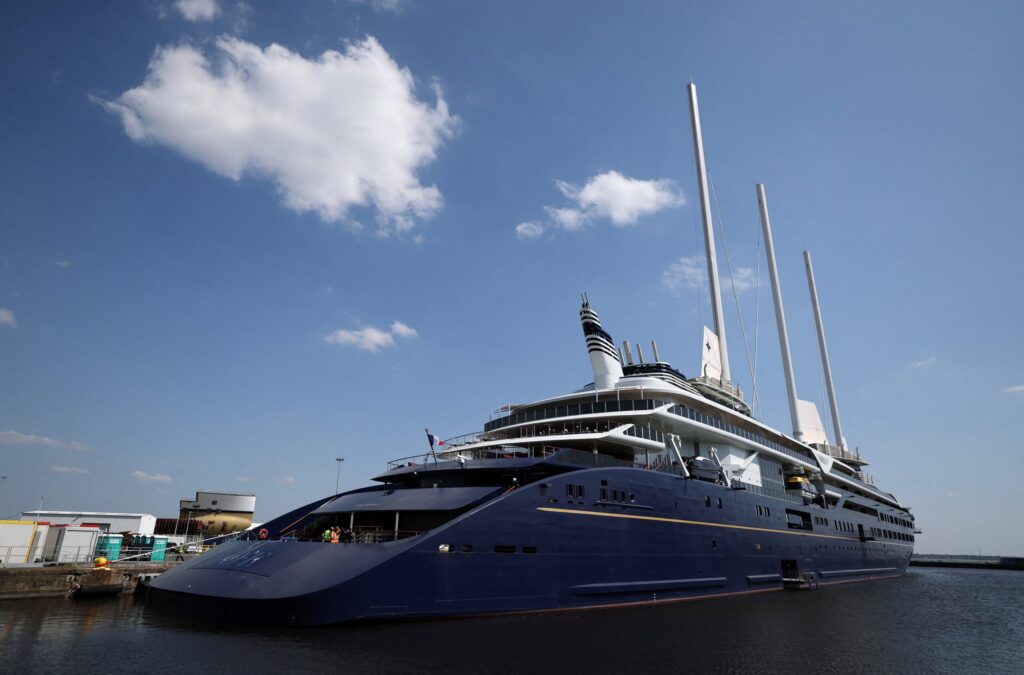
View of the Orient Express Corinthian, a luxury sailing cruise ship, moored at the Chantiers de l’Atlantique shipyard in Saint?Nazaire, France, April 28, 2026. REUTERS/Stephane Mahe
The Mediterranean’s Super-Yacht Summer Is Moving West This Year
By Clara Hernanz Lizarraga
May 2, 2026 (Bloomberg) –The summer yachting season is beginning to fill up along the docks of the Mediterranean, just not in the places many in the industry expected a few months ago.
From Barcelona to Mallorca and the French Riviera, marinas are gearing up for a strong season as owners redirect their plans away from the eastern Mediterranean, where tensions linked to the war in Iran have increased security concerns in one of the world’s busiest luxury cruising corridors.
The shift is proving a boon for western Mediterranean ports, while leaving some of the largest yachts effectively stranded in the Gulf.
“France, Italy and Spain will see a very good season,” said Sasha Romashova, corporate commercial manager at Ocean Capital Partners, which oversees more than €1 billion ($1.2 billion) in port assets, including marinas in Málaga, Ibiza and Seville.
Would You Sail Through a War Zone? These Yachts Did—Here’s How They Survived The Red Sea
While the Mediterranean remains the core summer destination for the global yacht fleet, security concerns are already influencing itineraries within the region. They have rippled across the eastern basin in recent months, from a drone strike on a British air base in Cyprus to Iranian missile activity targeting Turkey, prompting owners and charter clients to rethink where and whether to cruise.
The result is a westward pull. In Barcelona, MB92’s super-yacht refit yard is already running close to full capacity, with similar pressure on its facilities in France.
“The big unknown when the war broke out was whether boats would be coming into the Mediterranean at all,” said Txema Rubio, MB92’s commercial director, adding that the company expects revenue to grow between 5% and 10% this year. “But the boats have returned. Our shipyard is packed.”
Marinas are seeing the same pattern. At Club de Mar in Mallorca, which recently expanded to accommodate larger vessels, bookings are being driven in part by a perception of safety.
“It’s being considered as a safe haven for these vessels,” said José Luis Arrom, the club’s director.
The picture is more complicated in the east. Even ports in Greece are being hit by the conflict, with some clients perceiving the country as being uncomfortably close to the hostilities in the Middle East and with traditional Gulf clients cutting back on travel.
Some of the world’s largest yachts remain in the Gulf, with limited ability to reposition through the Strait of Hormuz, according to Henry Smith, a partner at Monaco-based brokerage Cecil Wright. For those vessels, the usual seasonal migration into the Mediterranean may not be an option.
“We anticipate the owners of these very big boats in the Middle East will have no option but to charter,” Smith said.
Among them are some of the industry’s most high-profile names, including the 180-meter
both previously linked to members of Abu Dhabi’s ruling family, and
a blade-shaped yacht associated with sanctioned Russian billionaire Andrey Melnichenko.
Even for those able to move freely, this summer’s cruising plans may look different. Operators expect shorter distances between stops and longer stays in fewer locations, as owners weigh fuel costs alongside lingering uncertainty over regional security.
Though for the ultra-wealthy, fuel costs are almost beside the point.
“It’s not such a huge cost unless you are running a very fast, gas-guzzling yacht,” Smith said. “You’ll likely be spending more drinking champagne than you would in fuel costs.”
© 2026 Bloomberg L.P.