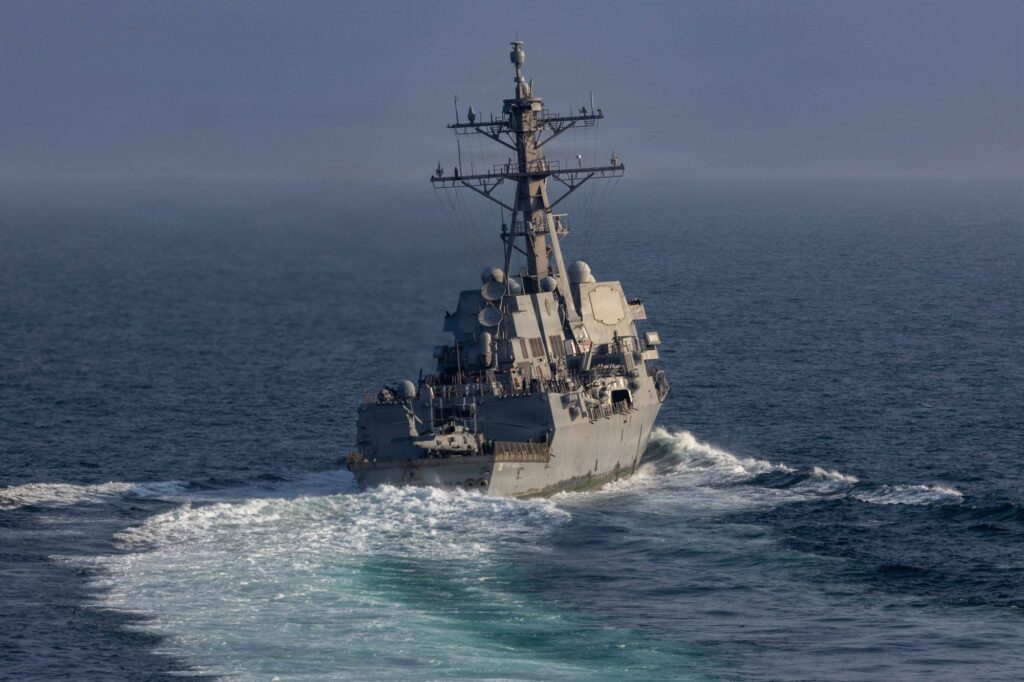
Arleigh Burke-class guided-missile destroyer USS Frank E. Petersen Jr. (DDG 121) sails in the Arabian Sea during Operation Epic Fury, March 18, 2026. (U.S. Navy photo)
U.S. Declares Blockade Effective as First Ships Turned Back from Iranian Ports
The United States says its newly announced maritime blockade targeting Iranian ports is already taking hold, with U.S. Central Command reporting that no vessels successfully transited in or out of Iranian ports during the first 24 hours of enforcement.
In a statement, CENTCOM said more than 10,000 U.S. personnel—backed by over a dozen warships and dozens of aircraft—are now actively executing the mission across the region.
“During the first 24 hours, no ships made it past the U.S. blockade,” CENTCOM said, adding that “six merchant vessels complied with direction from U.S. forces to turn around to re-enter an Iranian port on the Gulf of Oman.”
The operation is being carried out by a sizable joint force, with an aircraft carrier strike group, guided-missile destroyers, and amphibious ships supported by surveillance aircraft, unmanned systems, and aerial refueling platforms—giving U.S. forces persistent air and sea coverage across the Gulf of Oman and the approaches to the Strait of Hormuz.
The move marks a clear escalation in the conflict, shifting from indirect disruption to direct enforcement at sea. According to CENTCOM, the blockade is being applied broadly and without regard to flag.
“The blockade is being enforced impartially against vessels of all nations entering or departing Iranian ports and coastal areas,” the command said, noting that it covers “all Iranian ports on the Arabian Gulf and Gulf of Oman.”
At the same time, U.S. officials are drawing a careful line between restricting Iran-linked trade and keeping global shipping moving through the region’s most critical chokepoint.
“U.S. forces are supporting freedom of navigation for vessels transiting the Strait of Hormuz to and from non-Iranian ports,” CENTCOM said.
Meanwhile, a U.S.-sanctioned tanker,
, linked to Chinese interests, was observed transiting out of the Strait of Hormuz into the Gulf of Oman after initially turning back when enforcement began. The medium-range tanker—blacklisted in 2023 for its role in Iran’s oil trade—has become a closely watched case for shipowners and traders trying to gauge how far U.S. forces will go, particularly given unclear cargo origins and erratic AIS signals amid ongoing electronic interference in the region.
appeared on AIS stopped at the north-western portion of the Gulf of Oman after appearing to have been turned around.
A second sanctioned tanker,
, which had previously called at an Iranian port, was also seen entering the Strait before stopping near the Iranian coast. The latest AIS broadcast shows it had also stopped in the same general vicinity of the
U.S. President Donald Trump has signaled that enforcement will hinge on a vessel’s connection to Iranian trade rather than its flag or ownership, with ships entering or departing Iranian ports—or supporting those flows—subject to interdiction.
Guidance from U.S. Central Command indicates the policy will be applied “without distinction,” while Trump has also warned that vessels complying with Iranian-imposed transit measures, including paying so-called “tolls,” could face action. Transit to non-Iranian destinations is not formally prohibited, leaving a wide—and highly discretionary—enforcement threshold for vessels operating in the region.
That distinction is already being tested. Early vessel movements suggest growing hesitation near the approaches to the Strait, with some ships reversing course rather than risk interception.