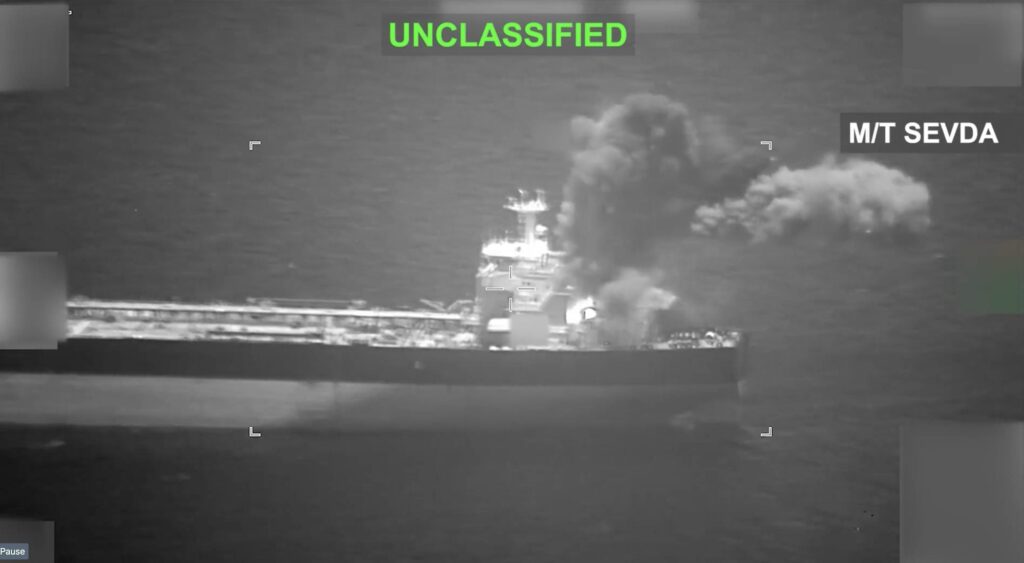
Thermal image released by U.S. Central Command appears to show the Iranian-flagged tanker M/T Sevda after being struck by U.S. forces in the Gulf of Oman on May 8, 2026. CENTCOM said a U.S. Navy F/A-18 Super Hornet disabled the vessel while enforcing Washington’s blockade on ships entering Iranian ports.
U.S. Navy Disables Two More Iranian Tankers as Hormuz Blockade Enforcement Intensifies
U.S. forces disabled two additional Iranian-flagged oil tankers in the Gulf of Oman on Friday as Washington expanded enforcement of its maritime blockade targeting vessels entering or leaving Iranian ports.
In a statement released Friday morning, U.S. Central Command said American forces intercepted and disabled the tankers
before the vessels could enter an Iranian port in violation of the blockade.
According to CENTCOM, a U.S. Navy F/A-18 Super Hornet launched from USS
(CVN 77) fired precision munitions into the vessels’ smokestacks, disabling both ships and preventing them from completing their voyage to Iran.
“All three vessels are no longer transiting to Iran,” CENTCOM said, referring to Friday’s operation and the earlier
disabling of the Iranian-flagged tanker
on May 6. In that incident, a Super Hornet launched from USS
(CVN 72) fired 20mm cannon rounds into the tanker’s rudder after the vessel allegedly ignored repeated warnings from U.S. forces.
U.S. Confirms Iranian Attack on U.S. Navy Destroyers in Strait of Hormuz
U.S. forces disabled two Iranian tankers, Sea Star III and Sevda, after the vessels attempted to breach the American naval blockade and enter an Iranian port.
According to the U.S. military, an F/A-18 Super Hornet fighter jet launched from the USS George H.W. Bush conducted…
pic.twitter.com/BHXV776NVp
— Visegrád 24 (@visegrad24)
The latest actions mark another escalation in Washington’s increasingly aggressive enforcement campaign tied to the U.S. naval blockade announced in April. The blockade applies to vessels of all nations entering or departing Iranian ports while allowing commercial traffic transiting to non-Iranian destinations through the Strait of Hormuz.
“U.S. forces in the Middle East remain committed to full enforcement of the blockade of vessels entering or leaving Iran,” CENTCOM commander Adm. Brad Cooper said in Friday’s statement. “Our highly trained men and women in uniform are doing incredible work.”
CENTCOM said multiple commercial vessels have now been disabled and more than 50 redirected since enforcement operations began.
The announcement comes less than 24 hours after CENTCOM confirmed Iranian forces
launched missiles, drones and fast boats at three U.S. Navy destroyers
transiting the Strait of Hormuz, triggering retaliatory American strikes on Iranian military facilities. President Donald Trump later claimed Iranian attacking forces had been “completely destroyed” during the confrontation and said the destroyers would rejoin what he called a U.S. “Wall of Steel” blockade around Iran.
The intensifying maritime confrontation continues to deepen uncertainty across global shipping markets and energy supply chains. Commercial traffic through the Strait of Hormuz remains heavily disrupted, with many operators still unwilling to resume normal transits amid missile attacks, drone strikes, sea mine threats and soaring war-risk insurance premiums.
Industry groups including BIMCO and the International Chamber of Shipping have repeatedly warned that commercial operators remain trapped between rapidly shifting military operations, uncertain escort arrangements and mounting security threats inside the Gulf.
BIMCO Chief Safety & Security Officer Jakob Larsen warned earlier this week that sudden operational shifts — including the Trump administration’s abrupt suspension of “Project Freedom,” the short-lived U.S. escort initiative for stranded commercial ships — have made risk assessments increasingly difficult for shipowners attempting to leave the region.
Meanwhile, humanitarian concerns continue to grow for the thousands of seafarers still stranded aboard vessels inside the Gulf. Indian sailors interviewed by Reuters this week
described nightly missile barrages, food shortages and weeks trapped aboard ships
near Iranian ports as commercial traffic through the region remains largely paralyzed.