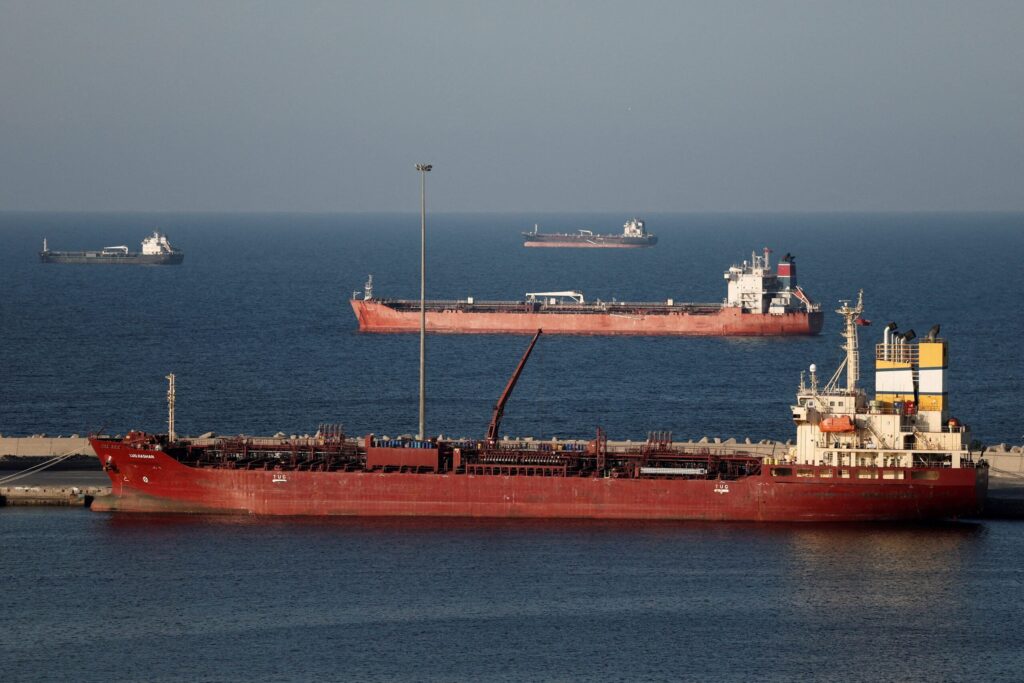
Luojiashan tanker sits anchored in Muscat, as Iran vows to close the Strait of Hormuz, amid the U.S.-Israeli conflict with Iran, in Muscat, Oman, March 7, 2026. REUTERS/Benoit Tessier
Bulk Carrier Hit by Projectiles Off Oman as Maritime Threats Spill Beyond Hormuz
A bulk carrier was struck by projectiles in the Arabian Sea off the coast of Oman last week, marking another incident as security risks continue to spread beyond the Strait of Hormuz.
The United Kingdom Maritime Trade Operations said it received a report on April 7 of an attack about 112 nautical miles southeast of Ras Al Hadd. The vessel’s master reported that the ship had been hit by “two unidentified projectiles,” sparking a fire onboard.
A Pakistan Navy vessel responded to assist, and authorities later declared the incident complete. No details were provided on casualties or the extent of the damage.
The report aligns with an alert from the Joint Maritime Information Coordination Centre Pakistan, underscoring continued monitoring of threats in the region.
Click here to read the full warning??
https://t.co/J0FHDI6d5f
pic.twitter.com/qjgfXWDOv6
— UKMTO Operations Centre (@UK_MTO)
While the strike occurred outside the Strait of Hormuz itself, the location—at the eastern approaches to the Gulf of Oman—places it along a key transit route for vessels entering and exiting the Gulf. In recent weeks, most attention has centered on disruptions and security incidents closer to the Strait, where traffic has slowed sharply amid the ongoing Iran conflict.
Separately, UKMTO warned on April 9 of “emerging reporting of a possible Pirate Action Group” near the Horn of Africa, advising mariners to remain vigilant and report suspicious activity. The warning follows a recent case in which a
hijacked fishing vessel off Somalia
was recovered after naval forces pressured pirates to abandon it.
Together, the incidents reflect a broader pattern of maritime attacks, piracy, and suspicious activity. Even as conditions inside the Strait of Hormuz remain uncertain, ship operators are being forced to consider a wider area of risk stretching across the Gulf of Oman and into the western Indian Ocean.